How to clean and display a PLA figurine
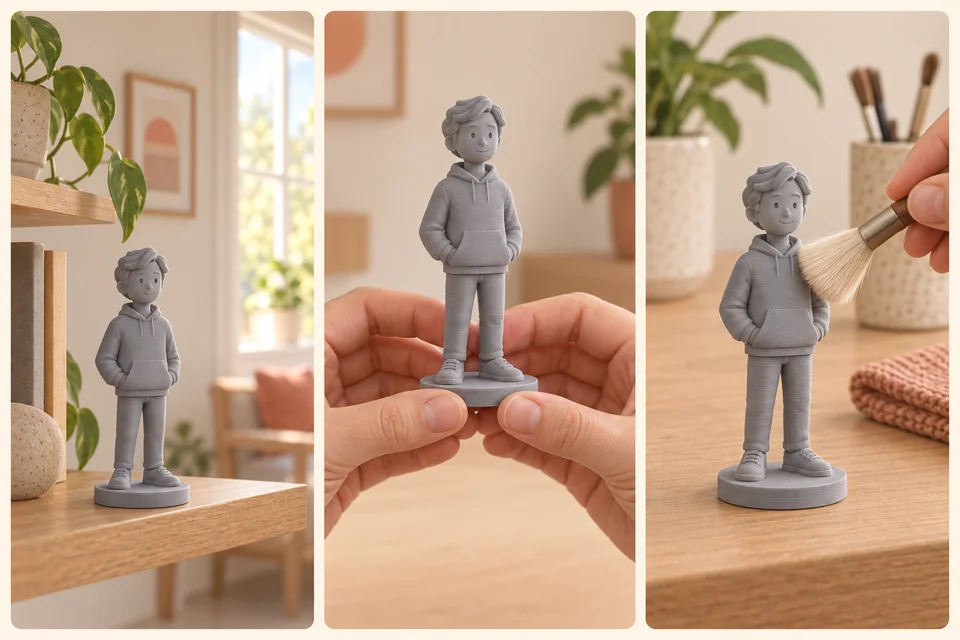
AI-generated educational illustration, not a photograph of a finished print. It shows care practices, not a material durability test.
- Choose a stable indoor surface, away from heat and direct sunlight.
- Lift the figurine by its base without pulling on accessories.
- Remove dust with a soft brush and light strokes.
Keep a personalised figurine made from a photo in a stable indoor spot, away from heat sources, and remove dust gently. Lift it by its base or a solid part, without pulling on the head, arms or accessories. These small habits matter particularly when the design includes thin or projecting details.
This guide offers a cautious approach to caring for a decorative, layer-printed object. It does not certify impact resistance, outdoor suitability or compatibility with cleaning products. The filament, shape and individual details can all affect how a piece behaves.
Choose the location before putting the figurine down
A stable shelf, bookcase or uncluttered desk is a sensible starting point. Make sure the entire base rests on the surface. Check that no accessory extends into a space where a hand, bag or cable is likely to catch it.
Look at the arrangement from more than one direction. An outstretched arm may appear compact from the front but project a long way to the side. Leave enough room to pick up nearby objects without touching the figure. If you move it regularly for cleaning, choose somewhere you can reach comfortably with both hands.
Keep the object away from small children and pets that might knock it over. A decorative figurine with thin parts should not be treated as a robust toy.
Avoid heat you cannot reliably control
Do not leave the figurine in a sun-heated car, on a radiator or near an open flame. A strongly sunlit windowsill is also an unwise choice: conditions can change substantially through the day.
The Bambu Lab filament guide distinguishes the thermal properties of different filament families. Those figures come from material test conditions. They do not tell you how long a particular figurine can remain on a radiator or in direct sun, so we do not suggest a universal “safe” household temperature.
A metallic effect does not turn PLA into heat-resistant metal. A marble effect does not give it the properties of a stone sculpture. Choose a finish for its appearance while keeping the same cautious approach to display.
Remove dust without putting pressure on details
Set the figurine on a clear surface. Use a clean, soft brush and light strokes over accessible areas. Support the base as you work. Around thin parts, avoid pushing sideways or forcing the bristles into narrow gaps.
A soft, dry cloth may help on broad, simple surfaces, but make sure it cannot snag an accessory. Do not use abrasive pads or try to scrub away the print lines: the layers are part of the object’s surface.
If a mark does not come off with gentle dry cleaning, stop and ask for advice about the specific piece. Avoid experimenting with solvents, hot water, soaking or a dishwasher. This is a precaution, not a claim that every filament reacts identically to every liquid.
Prepare the destination before you move it
Clear the place where the figure will go, then hold the base with both hands if its shape allows. Do not use a projecting feature as a handle. For a couple sharing one base, support the object from underneath instead of lifting one of the people.
For a longer journey, keep packaging fitted to the piece if it is available. Protect the figure without squeezing its arms or accessories, and limit movement inside the box. A bag containing other objects is not adequate protection on its own. Before shipping it again, ask for packing guidance suited to the actual shape.
What to do if you notice damage
A regular print line is not necessarily a crack. However, if you see a separation or a part starts moving, avoid bending it to test the damage. Put the piece down and take a close photograph of the area, along with a view of the whole object.
Do not immediately apply glue or heat. An attempted repair may change the surface and make the problem harder to assess. Use the Formacara contact form to describe what happened. Repairability cannot be promised without seeing the individual case.
If you are still planning your figurine
The eventual display space can help you choose the pose and overall dimensions. A compact composition may be easier to place on a small desk; an open pose needs clear space around it. Try your photograph in the configurator and keep those practical needs in mind when reviewing the illustrative preview.
Checkout is currently in test mode, and a simulation does not start real production or delivery. For a figurine you have already received, any care instructions supplied specifically with the piece take priority over this general guide.