Ancient figurines: images, purposes and people
A small human figure can feel immediately familiar. We recognise a face, an outfit or a gesture and begin imagining the person who wanted it. With an ancient figurine, that apparent familiarity can be misleading. Something that would look at home on a desk today might once have belonged in a tomb. A lively face might represent a general type, while a conventional figure might refer to a particular person whose name appears in an inscription.
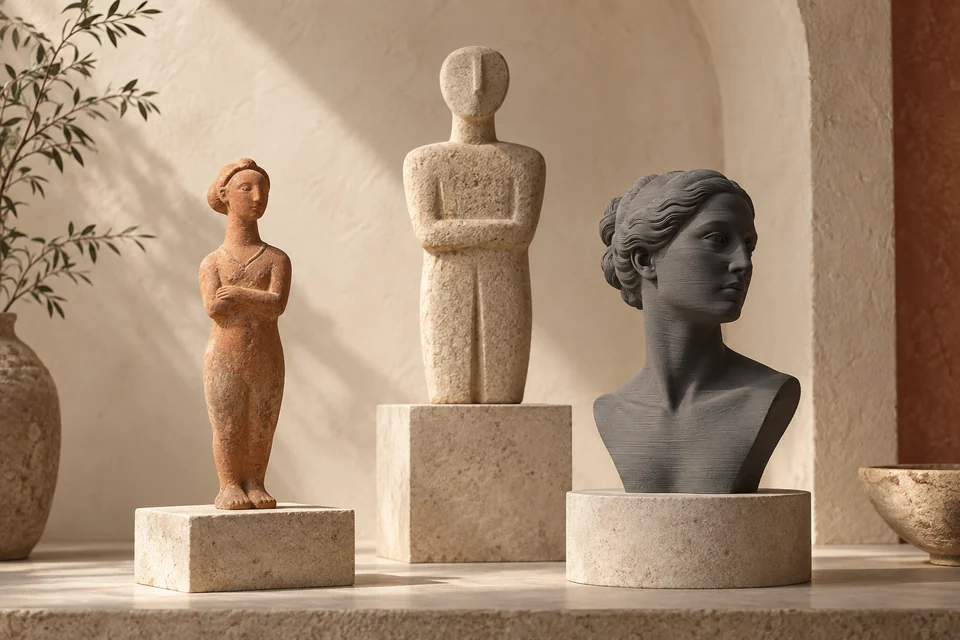
AI-generated editorial illustration: three fictional figures for comparing forms and materials. These are not identified archaeological objects or evidence of a historical sequence.
In this guide
The useful question is therefore not only “Who is this?” but also “What was this object expected to do?” Praying on someone's behalf, accompanying the dead, making a deity present, expressing status and remembering an individual are different possibilities. They do not form a necessary sequence from primitive religion to modern decoration. Nor are they always mutually exclusive. Understanding the differences makes these objects more interesting, rather than less approachable.
This guide follows selected evidence from Mesopotamia, Egypt and the Aegean, Greek and Roman worlds. It is a focused route through documented examples, not a universal history of miniature figures. Object information comes from museum catalogues and research; comparisons with present-day commissions are offered as ways of looking. For anyone exploring personalised 3D figurines, the central distinction is simple: a shared human shape does not imply a shared purpose.
What do we mean by a figurine?
In everyday English, a figurine is a relatively small sculptural figure. The word tells us something about perceived scale, but very little about purpose. It does not establish material, cost, importance, subject or intended setting. A figure only a few centimetres tall can involve considerable skill, while a larger object can deliberately use simplified forms. Small does not automatically mean easy, inexpensive or insignificant.
Other labels answer different questions. A portrait refers to an individual. A votive object belongs to a relationship of offering. A funerary object has a connection with burial or the dead. A deity describes the subject, where that identification is supported. These categories can overlap, but none follows automatically from the others. A small portrait could be an offering; that possibility does not prove that every small portrait was one.
The word “idol” needs particular care. It is sometimes used casually for an unfamiliar ancient figure, yet it already implies a religious interpretation. Where the function is uncertain, the label supplies an answer before the evidence has been considered. A neutral description is often more useful: a seated figure, a marble female figure, a bronze horse or a body with movable limbs. Interpretation can follow the description.
The same distinctions help with contemporary work. A made-to-order figure need not be a likeness of a real person: it could represent an occupation, an imaginary character or a symbolic scene. Conversely, an object produced in several versions can portray an identifiable individual. Whether an object is unique, whether its subject is known and whether it resembles that subject are three separate questions. Keeping them separate gives us a much clearer vocabulary.
Why context matters more than first impressions
Imagine two visually similar figures. One was recorded during an excavation in an identified setting; the other entered a collection without reliable information about where it was found. We can compare their shapes and materials, but we do not have the same basis for explaining their use. Context is not an optional background story. It is part of the evidence that makes an object intelligible.
A careful catalogue distinguishes a proposed place of manufacture from a findspot and from later ownership. “Found in a grave” does not necessarily mean “made only for burial”. An object may have had an earlier use. A broad geographical attribution is different from a documented position inside a particular building. “Attributed to” an artist is not the same as a surviving signature. Small differences in wording can carry substantial differences in certainty.
Missing information should remain missing. If the person's name is unknown, a modern title does not restore it. If a face seems calm, we can describe that visual impression without claiming to know the represented person's feelings. If an arm is lost, the present silhouette may not be the original one. An informative catalogue often earns our trust precisely by marking these gaps.
A practical reading method is to separate three levels. First, what can be observed: surviving parts, material and visible inscriptions. Second, what is documented or argued from comparisons: context, dating and identification. Third, what is proposed about meaning. We do not need to become archaeologists to make this distinction. We simply need to avoid giving every sentence in an explanation the same degree of confidence.
This approach also makes museum visits more rewarding. Instead of looking for a single story to memorise, we can ask how each part of the story is known. A question that remains open is not a defect in the object. It is an invitation to understand the limits of the surviving evidence.
Mesopotamia: a presence that continues to pray
The Met’s Tell Asmar worshiper, approximately 2900–2600 BCE, stood in a temple to pray for the person represented. Clasped hands and open eyes characterise this sculpted presence. The Met’s object record.
The essential issue is not whether its nose matched a person whom we can no longer see. It is the relationship between figure, person and place. A posture that a living body could sustain only temporarily becomes a lasting condition of the sculpted body. Treating it simply as an appealing small character would miss that relationship.
Comparison with a modern portrait therefore needs boundaries. Both objects can connect a person to a physical representation. That does not mean their owners expected the same things from the connection. The familiar modern idea of an affectionate keepsake cannot simply replace the particular function described in the ancient setting. The resemblance is formal; the expectations surrounding the form differ.
The example also challenges our habit of judging every figure against photographic naturalism. Enlarged eyes, a frontal stance or a repeated gesture need not be discussed only as departures from a camera-like image. We should ask what those choices allow a figure to communicate. A sculpture can work powerfully without pretending to be a person caught unawares in everyday life. Our preference for spontaneity is a preference, not a timeless neutral standard.
A second Met object, catalogued as Votive figure, is identified as Sumerian, made from white stone and dated approximately 2600–2350 BCE. Its short record supplies much less interpretation. That difference matters: we should not transfer every explanation attached to the first object onto the second merely because their cultural classifications are related. Record for the votive figure.
Cycladic figures: the value of an unanswered question
The Museum of Cycladic Art emphasises that the meaning of Cycladic figures remains debated. Written evidence is absent, and many archaeological contexts were damaged by looting. Numerous documented examples come from graves, but interpretations such as fertility goddesses should not be presented as certain identifications. Museum of Cycladic Art, function and meaning.
Saying that a question remains unresolved does not drain these objects of significance. It lets us examine how interpretations are built. A recurring posture can suggest a shared convention without supplying the name of a deity. A physical feature may matter without explaining an entire belief system. An object deposited with a burial may also have mattered to living people before that moment.
This is why a universal story in which every ancient female figure represents motherhood is inadequate. The interpretation may feel intuitive, but a visitor's intuition is not a substitute for comparing evidence. Modern categories are useful when they help us formulate questions. They become restrictive when they stop us considering alternatives.
The pale surviving surface can encourage another modern reading: pure form without descriptive detail. Yet the Met's digital project on Cycladic sculpture discusses pigment remains and traces of lost painted features. What survives is not necessarily everything that the ancient viewer saw. The Met's Cycladic sculpture viewer.
The implication is quite practical. Before describing abstraction as an absolute artistic choice, we should distinguish carved form from lost surface decoration. This does not permit us to invent colours for an individual object. It asks us to hold two things in mind: the present appearance, which we can examine, and an original appearance that may be only partly recoverable. The distance between them belongs to the object's history.
An encounter with these figures can therefore remain both direct and cautious. We can respond to their balance or silhouette while recognising that our response does not reveal their original function. Enjoyment and uncertainty can coexist. We do not have to solve an object completely before taking it seriously.
Egyptian shabtis: identity through a name and a role
Shabtis show how a figure can belong to a particular person without operating like a photographic portrait. The Met describes examples intended as substitutes for the deceased, sometimes bearing names and titles. Later forms can include agricultural tools and texts concerning work in the afterlife. The category is not uniform in inscription, attributes or appearance. The Met, Middle Kingdom shabti fragment.
A name changes how we think about personalisation. A figure can look broadly similar to many others while a written text creates a specific relationship. The face does not have to carry the entire burden of identity. That is a significant difference from a contemporary commission judged mainly by whether friends or relatives recognise someone's features.
National Museums Scotland stresses the long duration and variety of shabtis. Its account includes figures prepared with space for an owner's name and an example whose earlier name was erased and replaced. A familiar form could therefore acquire a different association. National Museums Scotland, a history of shabtis.
It would still be misleading to call these simply ancient personalised products. The analogy highlights one material arrangement: a prepared object combined with individual information. It does not explain the religious meaning, workshop practice or relationship with the deceased. An analogy earns its place only when its limits remain visible.
There is another temptation to resist. A miniature worker can appear charming, and charm may dominate a modern display photograph. But a funerary interpretation belongs to specific practices and expectations. Respecting that context does not require us to share the beliefs. It requires us not to replace them with a reassuring story about collecting attractive little figures.
The object also raises a broader question about recognition. Who needed to understand the relationship, and through which signs? A contemporary viewer may not be able to read an inscription, yet the writing can still be central to the ancient object. What is visually immediate to us is not necessarily what mattered most to the people for whom it was made.
Meketre's models: people within a system of work
The Met's bakery and brewery model from Meketre's tomb dates to approximately 1981–1975 BCE. Figures occupy different working positions within a modelled architectural setting. The group was found in a chamber containing other models associated with the burial. The Met, Model Bakery and Brewery.
In such a group, no single figure contains the whole meaning. Relationships between bodies, equipment and rooms make an activity legible. To understand the arrangement, our attention moves from an individual to the surrounding scene and back again. That is different from looking at an isolated bust, where the face tends to organise the encounter.
A modern reader might compare this with a commissioned scene about someone's profession. The comparison concerns visual organisation, not an identical function. A recognisable action does not turn every worker in the ancient model into an individual portrait. A gesture can communicate an activity, a role or a sequence without documenting a named person.
This helps distinguish narrative precision from individual identification. We can understand what is happening in a scene without knowing who its participants are. Conversely, a contemporary figure might have an identifiable face but an unclear action. A meaningful composition depends on the relationships between elements, not only on the likeness of its most prominent head.
A useful looking exercise is to imagine removing one element at a time. Would the action still make sense without a tool? Would the arrangement of figures remain readable without its setting? This is an exercise in present-day observation, not a claim about an ancient maker's intentions. It helps us notice how much of a scene's meaning is carried beyond the face.
Geometric horses: a small object need not have a private meaning
A bronze horse in the Met, dated 750–725 BCE, belongs to a type deposited as an offering at Greek sanctuaries. The museum associates the subject with the prestige of horse ownership. Its geometric form emphasises selected features, while the tail extends to the base and contributes to the figure's stability. The Met, Bronze horse.
Here recognisability, construction and visual form meet. Every anatomical detail does not have to be reproduced for a horse to be unmistakable. What looks like a stylistic feature can also contribute to physical support. In a small sculpture, visible simplicity may result from coordinated choices rather than a lack of care.
We should not turn that observation into a universal code. Every ancient horse does not necessarily communicate the same message, and every supporting element does not carry symbolic meaning. The individual object, its type and its context still matter. A persuasive interpretation connects evidence; an easy but unreliable one invents a dictionary in which a horse always means power and a smile always means happiness.
This is also a reminder to look beyond human figures when thinking about representation. An animal can have social or religious significance without being the portrait of a particular animal. The question of individuality should be asked, rather than assumed, whatever the subject happens to be.
Tanagra figurines: variety within a mould-made tradition
Tanagra figurines take their name from the Boeotian site where many examples were found. The Met describes a repertoire established in the last quarter of the fourth century BCE, notably clothed women and girls. Separately moulded elements and changes to head and arm positions allowed related forms to acquire different poses. The Met, Tanagra Figurines.
Their dress and attitudes can feel close to modern interests in personal style. That response is understandable, but it does not prove that every figure depicts a customer or a known individual. A natural-looking figure can represent a type. Variation in pose is not automatically personal portraiture.
Mould production also unsettles a simple opposition between repetition and expression. Two figures sharing part of their manufacture can create different impressions. A turn of the head, a change of arm position or an accessory can alter the rhythm of the whole. Technical repetition and meaningful selection are not necessarily enemies.
Try looking first at the outer contour, then at the direction of the face, and finally at the lines formed by the clothing. A sense of movement may depend on surprisingly small relationships. This is a way of examining the figure today; it does not reconstruct the intentions of every maker. Its usefulness lies partly in the fact that it does not require an invented biography for the subject.
Even “elegance” remains a modern judgement. We can use the word to describe an effect, provided we do not mistake that effect for evidence of function. An accomplished figure could participate in ritual practice. A religiously significant object could also be carefully fashioned. Beauty, technique and purpose need not occupy separate compartments.
The question becomes more interesting when we abandon the demand that a figure be either wholly unique or wholly standardised. We can ask instead where variation occurs, what it changes and how much individuality we are justified in reading into it. That question remains useful far beyond ancient terracotta.
Articulated figures: calling them dolls does not settle their use
Some Greek terracottas have movable limbs and suspension holes. In the Met's discussion, Maya Muratov explains why automatically identifying the entire category as children's toys is inadequate. Contexts and interpretations vary. Movement is a material fact, but a single purpose has not been securely established for every example. The Met, figures with articulated limbs.
The case begins with a familiar reaction: we see a small body that moves and think of play. That is a reasonable question. The mistake would be treating the answer as self-evident. Resemblance to a modern object makes one interpretation instantly available, which can also make competing interpretations harder to notice.
Caution need not produce a vague description. We can state where the joints are, which parts survive and how the body could move. We can then distinguish proposals about use. Precision does not mean speaking with confidence about everything. Often it means identifying exactly where observation ends and an explanation begins.
This is a useful habit for any object that looks surprisingly modern. Familiarity can provide a route into the subject, but it should not become the evidence on which the whole account rests. The most interesting ancient objects often remain partly unfamiliar after we have learned more about them.
Roman household figures: domestic does not simply mean decorative
The Met's bronze statuette of a Lar, dated to the first or second century CE, represents a deity associated with the household. Its catalogue connects the lar familiaris with family protection and identifies vessels used as attributes. The setting is domestic, but the interpretation is not merely ornamental. The Met, Bronze statuette of a Lar.
The distinction challenges a common opposition between public importance and private sentiment. An object inside a home can belong to religious practice. A house is not a culturally identical space in every period, and finding a small figure within one does not demonstrate a purpose comparable to that of a contemporary keepsake.
Attributes also help identify a subject without depending on an individual face. A held object can make a deity or role recognisable. Today, a ball or musical instrument can make an activity readable. The visual mechanism can be compared, but its meanings are not interchangeable. We can recognise a formal connection without collapsing different categories of object.
For a modern commission, this suggests a restrained lesson: an accessory should do a particular job in the composition. It need not accumulate meaning simply because it is recognisable. The historical case broadens our attention to what a figure holds and how it is situated; it does not supply a ready-made symbolic formula for every new design.
A Roman portrait is not a photograph before photography
The Met's account of Roman portraiture describes changing veristic and classicising approaches, including their relationships with authority and dynastic models. These choices do not form a straightforward march towards optical accuracy. An aged or idealised face can participate in a larger message. The Met, Roman Portrait Sculpture: The Stylistic Cycle.
Visible wrinkles do not guarantee that each wrinkle is an impartial record of a person's skin. Equally, a youthful image does not establish the sitter's age when it was made. Without an independent photographic comparison, we cannot assess likeness as we would with a family member. We can examine how an image is constructed and what evidence accompanies its identification.
That distinction also protects the idea of portraiture from an unnecessarily narrow definition. A portrait need not cease to be a portrait because it selects, idealises or emphasises particular features. We need to ask what identity it communicates and to whom. Reducing it to a contest in accuracy excludes clothing, posture, setting, scale and relationships with other images.
For the practical side of those choices, our guide to sculptural portraiture, likeness and pose considers how artistic observation can inform a contemporary commission. The historical point here is narrower: individuality and naturalism are not identical, and a face does not exist independently of the rest of its representation.
The surviving white surface is only part of the story
The Met's Chroma exhibition examined evidence for colour in Greek and Roman sculpture, including surviving traces and their investigation. Many works now encountered without colour were painted. Reconstructions help explore that evidence; they are interpretations of varying completeness, rather than photographs of the ancient appearance. The Met, Chroma.
This changes how we use the phrase “classical style”. If we choose a pale, single-colour figure today because we enjoy the appearance of marble, we are making a contemporary aesthetic choice. We do not need to justify it with the claim that all ancient sculpture was intended to be white. A reference can be meaningful even when it draws on the later reception or surviving appearance of an object.
The same applies to worn surfaces. A softened detail, fracture or patina may contribute to an object's appeal today without having belonged to its original design. Time changes what we encounter. Appreciating the surviving form does not require us to confuse it with the figure as it left the workshop.
It also follows that a reconstruction should be labelled honestly. “Evidence for colour” and “certainty about every original colour” are different statements. A clear explanation can preserve the excitement of discovery while making the boundaries of knowledge visible. There is no need to trade accuracy for a more dramatic story.
Material, scale and importance are separate questions
Material can dominate our judgement in a gallery. Marble and bronze may immediately suggest prestige, while terracotta or wood seem more modest. That hierarchy is too quick. Without evidence about making, setting and use, the material's name alone cannot establish how much an object mattered to those who commissioned or encountered it.
Size is not a universal measure of importance either. A small object may be intended for a particular relationship and a large monument for a wider audience. These are possibilities, not rules for every society. The practical question concerns the situation: was the figure to be seen at a distance, placed in a restricted space, accompanied by other objects or examined closely?
Check the actual measurements when reading a record. A photograph isolates its subject and can make a tiny figure appear monumental. The screen does not automatically restore the relationship between the object and a human body. Numerical dimensions do not reproduce the full experience of scale, but they prevent an interpretation from depending on an imagined size.
These observations also help with present-day decisions. A figure beside a monitor and one on a distant shelf present different questions of visibility. We do not need to assign modern display habits to ancient people to recognise that object, setting and viewer form an important relationship in sculpture.
A useful exercise is to separate what a material looks like from what it is. A contemporary surface can suggest stone without being stone. That visual association may be intentional and enjoyable, but it should not replace a clear description of the material. Historical references are more convincing when they are specific rather than inflated.
Three scales: a figure, an animal and an environment
The Met records 29.5 × 12.9 × 10 cm for the Tell Asmar worshiper, 10 × 6.2 cm for the bronze horse, and 73 × 55 × 29 cm for Meketre's bakery and brewery, whose figures average 21 cm in height.
Those measurements change the comparison immediately. The worshiper is almost three times the horse's height, a difference concealed by photographs displayed equally tall. The Egyptian model occupies a substantial horizontal area in relation to its individual figures. It is an environment containing relationships between people and activities, rather than simply a larger statuette.
Imagine drawing the recorded outlines at one common scale on a sheet of paper. Three experiences would emerge: a vertical presence, a compact animal and a space through which the eye can travel. Enlarged details remain useful, but this simple map restores a relationship that isolated photographs often remove. It brings physical size back into the discussion before we evaluate fine features.
The comparison also separates the size of a subject from that of the complete work. In Meketre's model, the average worker's height and the overall dimensions answer different questions. A contemporary couple composition raises a similar distinction. The people's height does not tell us how much space their separation, accessories and base will occupy. Overall measurements describe the object that needs a place; an individual body's height describes one part of it.
What changes with a contemporary figurine made from a photograph?
A modern photographic commission begins with an explicit purpose: representing a selected person, couple or gesture. People who know the subject can participate in evaluating the result. There are reference images, stated preferences and an intended setting. These conditions are very different from those under which we interpret an excavated object.
Even now, “personal” includes several possibilities. A person can be recognised through a face, a familiar stance, clothing or a shared scene. A couple's figure might prioritise the relationship between two bodies; a sporting keepsake might centre on one gesture. There is no single form of individuality, and asking only how realistic the figure will be can leave the most important intention unstated.
History can help us formulate better questions without becoming an advertising argument. What must make the subject recognisable? Which feature would be a mistake to simplify? Does the figure represent one occasion or a person's more enduring character? Should its base simply support the body or carry a meaningful inscription? These are current design questions; we do not need to claim that people answered them identically for thousands of years.
For the contemporary service itself, see the page about a custom figurine from a photo. Its purpose is to explain a present-day project. Historical comparison remains a cultural resource here: it can make choices more thoughtful, but it cannot guarantee likeness, artistic achievement or durability by association with ancient masterpieces.
Using an ancient reference precisely
A historical reference becomes useful when it is specific. You might admire a contained posture, a clear silhouette, the relationship between clothing and body or the way several figures occupy a shared base. Describing that feature is more informative than asking for something vaguely ancient. A broad label can mix periods, places and purposes that have little in common.
Inspiration also differs from reproduction. Borrowing a compositional idea does not mean making a copy of an archaeological object. Reproducing an identified work introduces separate questions about documentation and how the result is described. A newly made PLA figure with a marble-effect finish is not ancient marble. Material and origin should remain clear.
The reference should not erase the person being represented. If the purpose is to remember a relative, a historicising costume or solemn pose needs to be considered in relation to that memory. Visual grandeur may be far from the character the commissioner wants to evoke. An artistic reference is an option, not a shortcut to a more meaningful portrait.
Two simple statements can help: “This is the relationship of forms I like in the reference” and “This is what I want to preserve about the person.” If they conflict, the conflict deserves an explicit choice. Learning about historical objects is also a way of deciding what not to borrow.
Read the materials list as a structure
For the worshiper, the Met lists gypsum alabaster, shell, black limestone and bitumen. For Meketre's model, it lists wood, gesso, paint and linen. These combinations differ from the horse's single designation, bronze. A materials field can open an investigation rather than merely attach a category.
The first list invites attention to contrasts between light and dark parts, and between the body and its details. The second suggests separating the supporting structure, surface preparation and the colour through which we see it. This is an exercise in looking; precise material distribution should be checked against object-specific technical information where it exists.
Thinking in layers also changes the question of finish. Colour may help distinguish clothing, anatomy or an element of a setting. It can contribute to how the scene becomes readable. In a single-colour presentation, relief and illumination take on more of that work, so apparently similar shapes may communicate differently under different surface treatments.
For these three objects, try recording structure, surface and visual contrast separately. The result is not a hierarchy of prestigious materials. It asks what each component contributes to the image. The same exercise can clarify a present-day choice between a uniformly coloured figure and a painted one. That decision concerns how the scene should be read, as well as a preference for a particular finish.
Three routes for the eye: centre, profile and sequence
Return to the same objects with a different question: where does the eye travel? In the worshiper, face and hands gather attention around the body. In the horse, profile makes the relationship between head, back and legs immediately apparent. In the workshop model, attention moves between activities. These are possible formal readings of the images, useful for comparing composition.
On the first route, begin at the face and move towards the hands, noticing how the gesture closes part of the figure. On the second, follow the outer contour and then the spaces between the legs. On the third, choose a worker and trace connections to a tool, container, another figure or a division in the setting. Each route brings different information forward.
This exercise works without assigning emotions to the subjects. A concentrated centre, a clear silhouette and a sequence of actions describe ways of organising an image. They can be recognised and discussed before deciding whether the work feels solemn, lively or familiar.
For a personal commission, these comparisons become concrete options. A bust concentrates attention; a sporting pose may rely strongly on its profile; a couple with accessories needs readable relationships between several elements. Ancient examples widen that compositional vocabulary. The eventual decision still belongs to the chosen subject and the intended setting of the new figure, rather than to a historical formula that must be followed.
Frequently asked questions
Were all ancient figurines religious?
No single function can be assigned to objects from different cultures, periods and settings. It is equally misleading to call them all decorative. The answer belongs to a category and, where possible, to an individual object. Everyday appearance does not exclude ritual use, and a divine subject does not reveal every occasion on which the figure was used.
Does a natural-looking figure necessarily portray a real person?
No. A credible pose, detailed clothing and a lively face can belong to a general type. Identifying a particular person requires additional evidence, such as an inscription or reliable documentation. Conversely, a conventional image can refer to a named individual. Naturalism and identity are related questions, but they are not interchangeable.
Why can similar figures mean different things?
Shape is only one part of an object's history. Setting, participants, practices and accompanying information can change. An inscription can also alter the relationship with a subject. Visual comparison is therefore a useful beginning and an insufficient conclusion. Similarity needs to be considered alongside context, rather than used as a substitute for it.
Can we judge the likeness of an ancient portrait?
We can study relationships between images, describe formal choices and consider scholarly identifications. Usually we cannot check the face against a photograph of its subject. Calling a portrait individualised differs from claiming that it faithfully reproduces every feature. The distinction makes our judgement more precise without diminishing the sculpture's value.
What is the most useful connection with personalised figurines today?
It is a shared question about representation: what makes a figure meaningful to someone? Historical answers are varied and should not be flattened into modern expectations. Today we can choose face, gesture, relationship and setting deliberately. Ancient figurines enlarge the vocabulary available for those decisions; they do not prescribe a formula for making them.