3D printed PLA figurines: what to expect from the real object
A PLA figurine can capture a recognisable pose, passion and face, but its surface is different from a photograph. Understanding the result means considering the model, its size, the printing process and the finish together. This guide explains how those choices interact, using a physical Formacara print and documentation from material and equipment manufacturers.
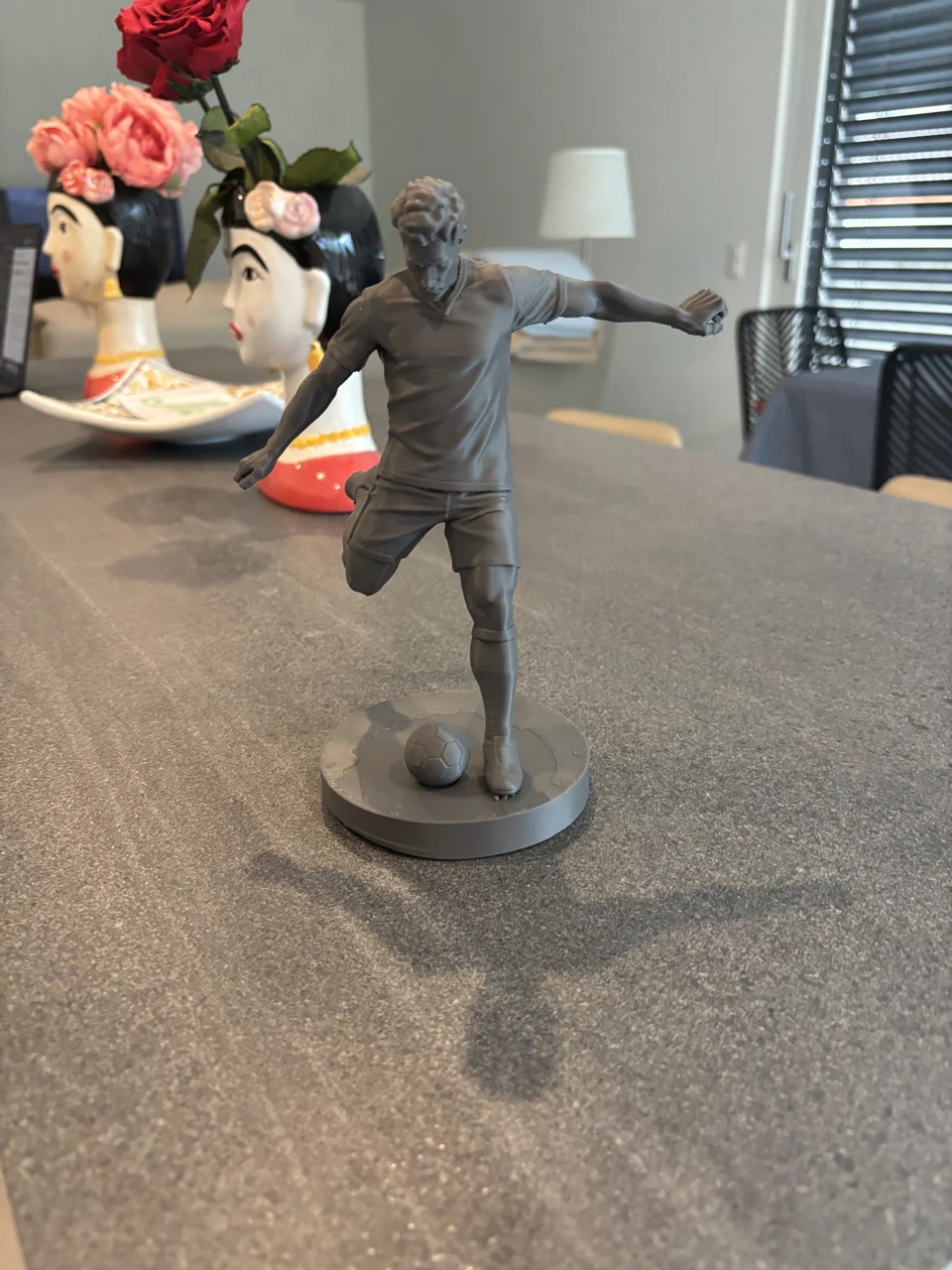
A real Formacara print in dark grey PLA Basic, showing the pose, details and physical surface.
To choose a subject, size and finish, visit our custom figurine from photo page. Here, we look more closely at the material and what makes a model suitable for printing.
What is a PLA figurine made of?
PLA stands for polylactic acid, a plastic supplied as filament for extrusion printing. The commercial formulation matters: Bambu PLA Basic’s safety data sheet lists PLA and additives. Knowing the polymer’s name does not tell you every property of each colour or finish. Bambu PLA Basic safety data sheet.
For a decorative figure, first consider where it will stand and how it will be handled. An indoor shelf, a sunlit car dashboard and an object carried in a backpack every day present very different conditions. This guide mainly concerns figurines displayed indoors.
FDM and resin are different processes
FDM, also called FFF, builds an object by depositing melted filament through a nozzle. Resin printing uses light to harden a liquid material; cleaning and, depending on the material, post-curing are separate steps. Resin technologies can reproduce very fine features with smoother surfaces. A useful comparison still needs specific printers, materials and physical examples. Formlabs’ technical comparison.
Compare close-up photographs of actual prints at the same size, rather than relying on a smooth render. If you need tiny facial features or ornaments to remain legible within a few centimetres, inspect those details. If the figure will sit on a desk, also consider its silhouette, gesture, base and finish. The Formacara service described here uses PLA, not resin printing.
From a photo to a model: what is preserved and what is interpreted?
A photograph records one viewpoint. The back of a jacket, a hidden hand or the gap between an arm and the torso may be unclear. An AI preview is a visual proposal; it is neither proof of an exact scan of the person nor confirmation that every detail can be printed.
Choose three clear priorities, such as posture, hairstyle and a football. Explain which other elements may be simplified. If recognition depends on small lettering, ask for it to be checked at the final size. Our photo-to-figurine process guide distinguishes the preview, the model used for estimation and the production file.
Size and scale: why a small face loses information
Overall height does not tell you how large the face will be. A full-body figure and a bust of equal height give the face different amounts of space. A stated measurement may also include or exclude the base. Ask for the finished height, width and depth, with the base clearly accounted for.
Consider a purely geometric example: shrinking a model from 20 to 10 cm without changing its design halves every linear detail. A 1 mm feature becomes 0.5 mm. This is not a printability threshold; it explains why reducing a file is different from redesigning it for a smaller size. An accessory might need to be thicker, meet the body at an additional point or sit in a different position.
To judge the footprint, cut a paper rectangle to the proposed width and depth and place it where the figurine will stand. An enlarged preview on a phone cannot replace this simple check.
Layers, nozzles and detail are not the same thing
Layer height describes the vertical steps of a print. Thinner layers can make steps on sloping surfaces less prominent, while increasing the number of passes. They cannot add detail that is missing from the model. Prusa: layers and perimeters.
Nozzle diameter and the actual width of deposited lines concern another direction of detail. Saying “printed at 0.1 mm” does not describe the object’s entire resolution. A face can have thin layers and still be hard to recognise because it is too small, simplified or poorly oriented for that feature.
Variable layer height allows finer vertical steps where the shape benefits from them, without applying the same setting everywhere. Its usefulness depends on the geometry and print profile. Prusa: variable layer height.
No single number proves that a print is “premium”. A useful assessment combines close-up views with the actual printing parameters, where those are available.
Orientation and supports affect the surface
Placing or tilting a figure changes which areas need support and which surfaces touch supports or the build plate. It also changes layer direction relative to stressed parts. Prusa’s documentation illustrates why a supported underside may look rougher than a side wall. Designing for 3D printing.
Consider which surfaces will be most visible: the face, chest and front of the base may deserve particular attention. There is no universally best rotation; a figure with outstretched arms presents different choices from a compact bust.
Supports are temporary structures. Contact gaps, interfaces and placement affect how they support the model and how easily they can be removed; the sliced preview needs checking. Prusa: support material.
Removing supports can leave small marks. “Supports removed” does not automatically mean sanded, filled and painted. When comparing proposals, check which finishing work is included.
Marble, wood and metal effects
A finish name primarily describes appearance. Marble-effect PLA is not carved stone. Its weight, feel and heat resistance do not become those of the material it resembles.
PLA Wood: Bambu describes a blend of PLA and wood powder. It is not solid wood; the product information also excludes a 0.2 mm nozzle. An aesthetic choice can therefore affect technical options. Bambu PLA Wood.
PLA Metal: the Bambu range cited here reproduces a metallic appearance without actual metal particle fillers. It should not be described as a metal casting. Bambu PLA Metal.
Formacara uses one filament per figurine: skin, clothing and accessories are not reproduced in separate colours. Consult the samples and our PLA finish guide. Screen colours remain indicative, especially when viewed under different lighting.
Heat, sunlight and impact: practical limits
Bambu PLA Basic’s V3.0 data sheet reports a heat deflection temperature of 57 °C under the ISO 75 test at 0.45 MPa. This is a specimen result under defined conditions, not a guaranteed operating temperature for a figurine. The document also explains that geometry and printing parameters affect performance. Bambu TDS, a hosted copy of the manufacturer’s document.
Choose a display position away from radiators, hot lamps and direct sunlight, and avoid leaving the figure in a car. Do not try to straighten an accessory with boiling water or heat: nearby areas may deform too.
Prusa’s material documentation identifies PLA’s sensitivity to UV and impact. It does not establish a universal lifespan for a particular figurine. Prusa: PLA properties.
Lift the piece by its base, rather than using an arm, racket or other thin feature as a handle. Start cleaning with a soft, dry brush and avoid forcing it into small gaps. For stains or more intensive treatment, ask for advice specific to the finish. We do not promise indefinite outdoor durability.
Is PLA biodegradable or compostable?
Material origin and waste treatment are separate questions. NatureWorks explains that industrial compostability of certain PLA grades does not automatically certify a finished product: additives, colourants and the final article require appropriate assessment. NatureWorks: regulatory information and industrial composting.
We therefore do not describe these figurines as home-compostable or biodegradable in nature. Keeping and using the piece for a long time is the first practical option. When disposal becomes necessary, check local instructions for the actual object; do not assume that PLA belongs in food waste or standard plastic recycling.
How to assess a figurine and a quote
Useful photographs show the front, at least one side and a close view of the surface. Look for lighting that reveals the relief without confusing shadows, colour and geometry. The footballer below is a physical print in dark grey PLA Basic: these photographs document one example, rather than predicting every possible subject.
Before comparing prices, establish what each proposal includes:
- Finished dimensions and whether the base is included.
- An identifiable filament and colour, plus any painting or later treatment.
- Model preparation and how changes are handled.
- Support removal and the intended level of finishing.
- The figurine price, shipping and destination shown separately.
The cost of filament alone does not cover all the work. Our figurine price guide explains the components; at this stage we do not publish unvalidated price ranges or example quotes. You can explore the configurator while orders and payments remain temporarily paused.
Frequently asked questions
Are visible layers always a defect? Layers are part of the FDM process. Their consistency, location and prominence should be assessed against the agreed result; a digitally smoothed image is not enough to judge it.
Is a larger figurine always better? It provides more room for detail but takes up more space. The model and pose still matter: enlarging a poorly defined file does not add information.
Can I request a face identical to the photo? You can identify the features to preserve and assess the preview, but it is not a guarantee of perfect likeness or an identical physical result.
Is the figurine a toy or food-contact object? This is a decorative product. PLA as a material does not, by itself, establish the finished piece’s suitability for those uses.
A real figurine, seen up close
This footballer is a physical Formacara print in dark grey PLA Basic, photographed from three angles. These are photographs of the printed piece, not simulations.
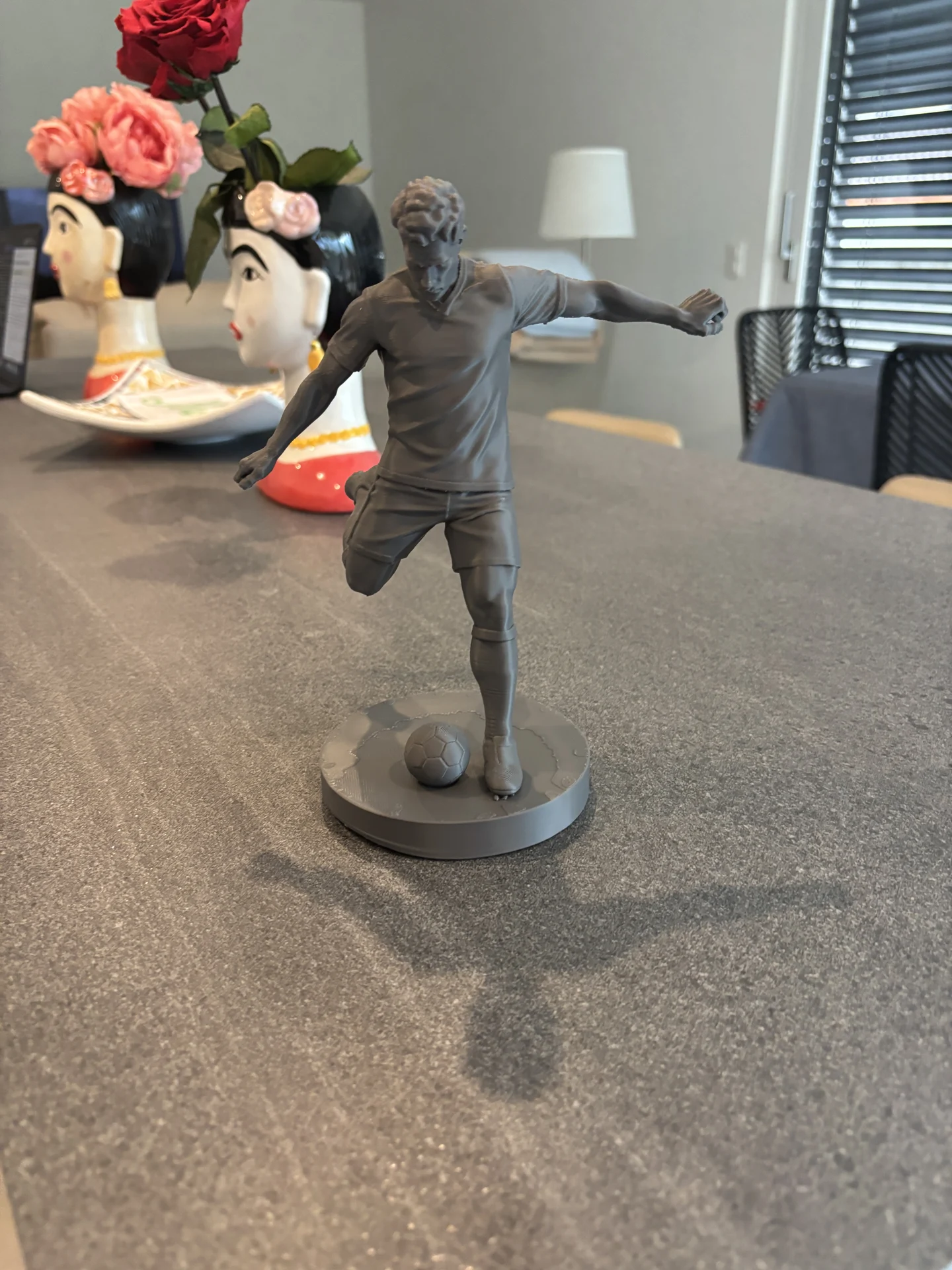
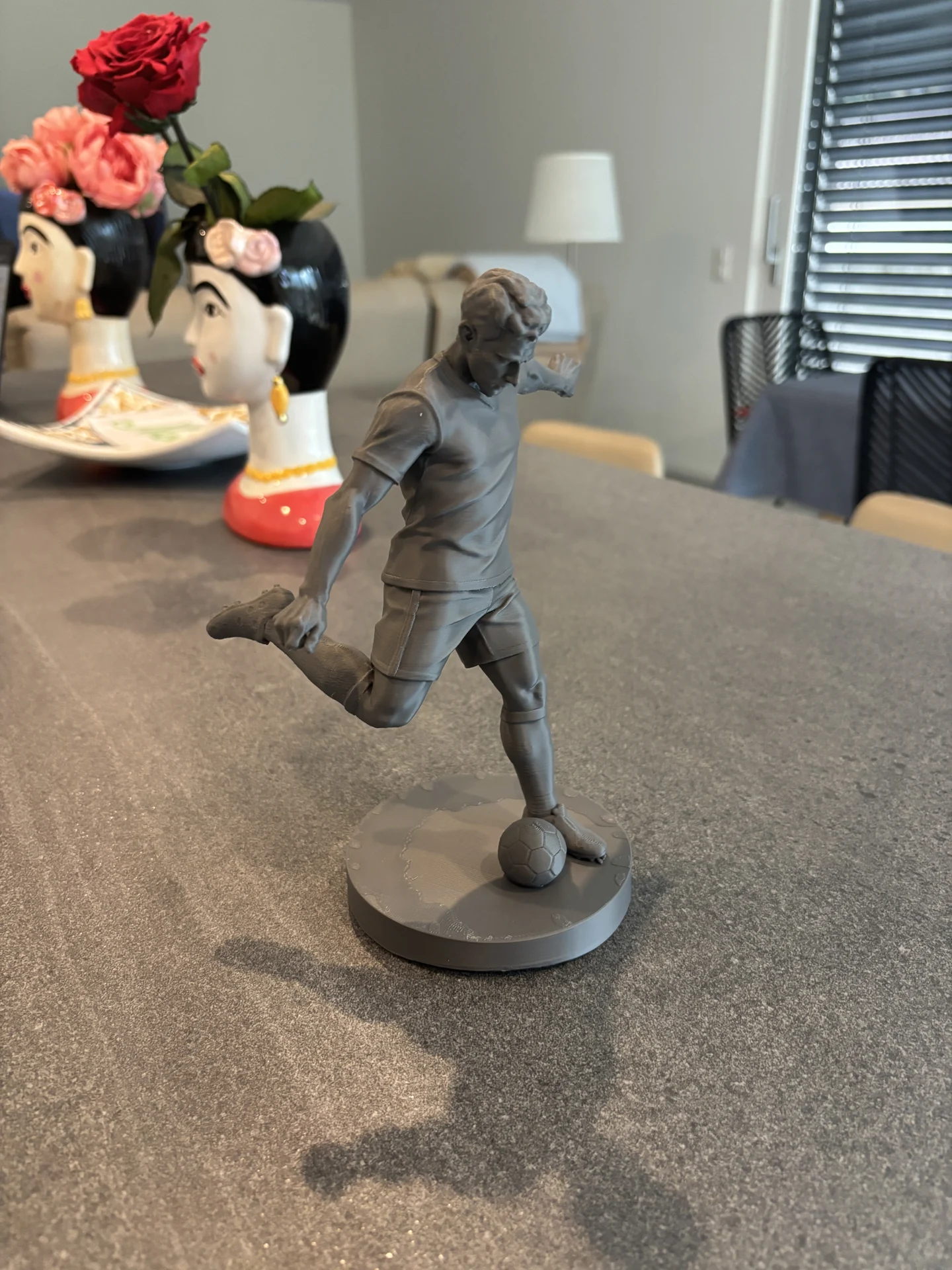
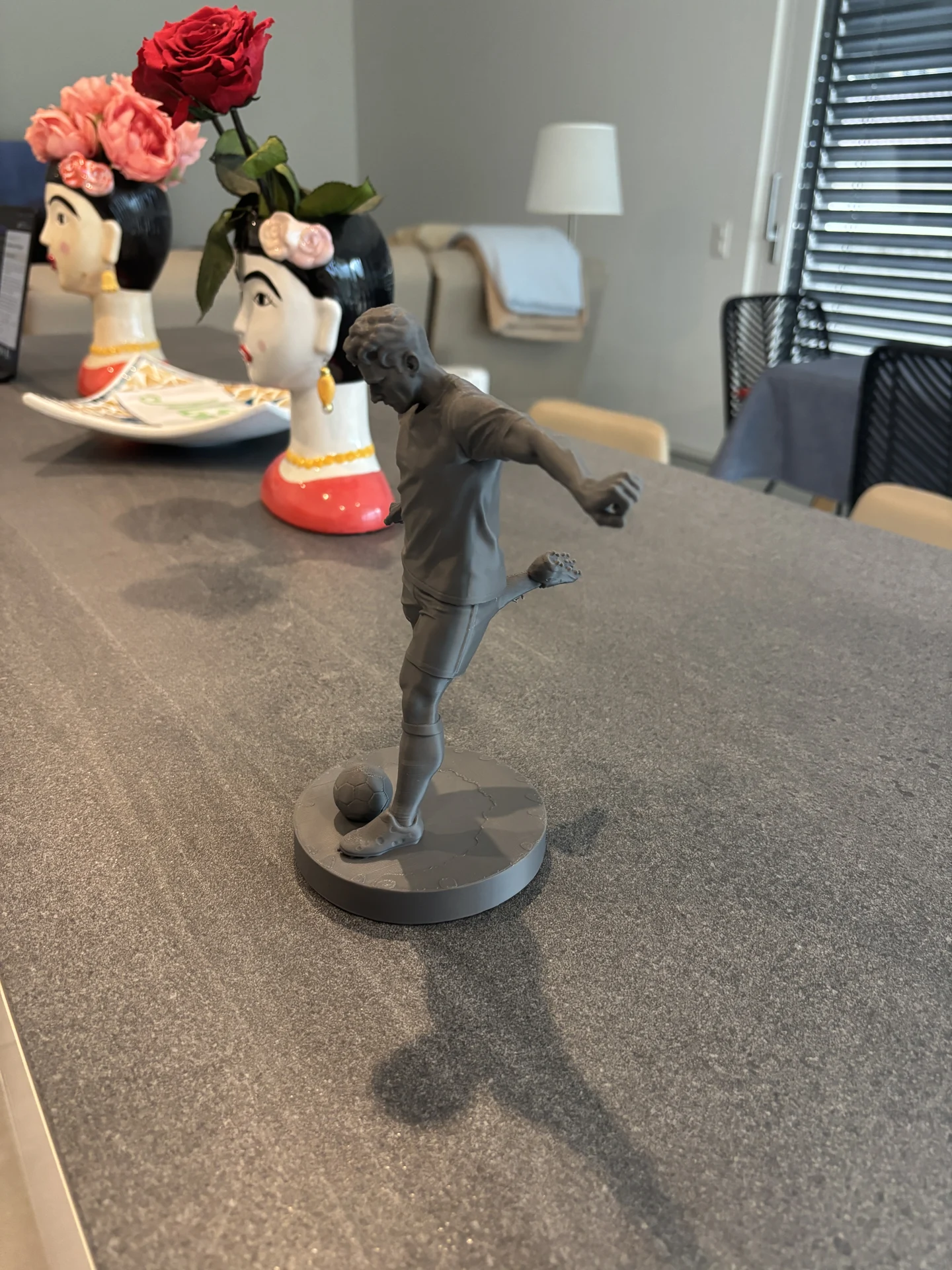
The photographs show the pose, football, folds in the shirt and base. Filament deposition marks are visible on the base; the face and tiny details do not have photographic definition. Lighting and shadows are part of the original photographs.
Detail depends on the subject, size and chosen finish. This example helps you recognise the surface of a physical PLA print.