Choosing the right figurine size for a desk or shelf
When choosing the size of a personalised 3D figurine printed in PLA, start with where it will stand. Height alone is not enough: check width, depth and the clear space around the whole figure. A compact standing pose and a figure with open arms can be equally tall while occupying very different spaces.
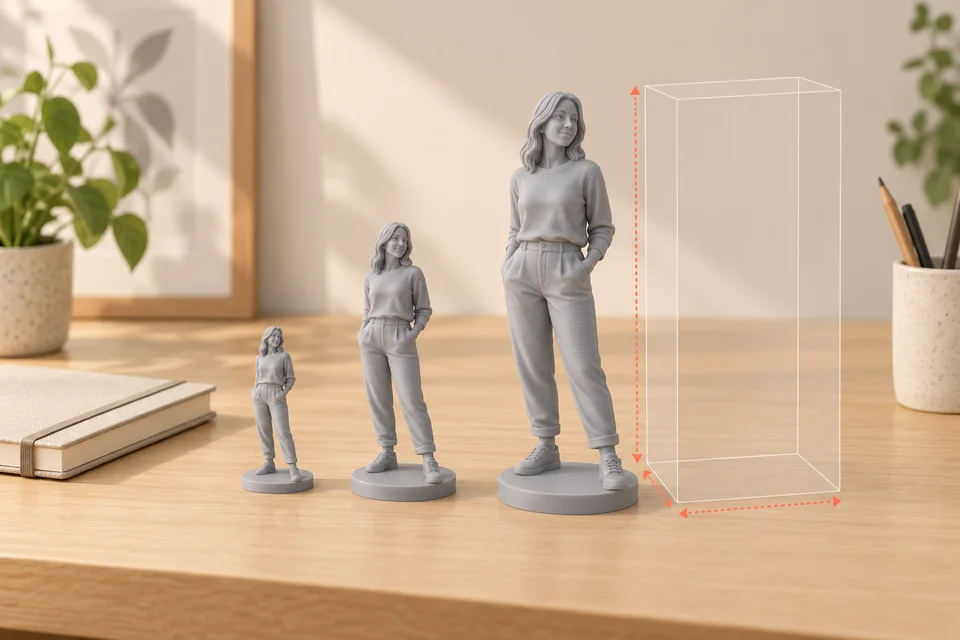
AI illustration for considering size, not a measured comparison or a range of purchasable sizes. Actual dimensions come from the 3D model.
There is no single ideal size for every desk. Your choice depends on how you use the space, where you will view the piece from and how far the composition extends beyond its base. A quick check on the furniture can help before you select a height in the configurator.
Measure the space you can actually spare
On a desk, identify an area that is not needed for your mouse, papers or cables. On a shelf, measure usable depth and the clearance beneath the shelf above. Use the narrowest relevant space, rather than the dimensions of the entire piece of furniture.
Place a sheet of paper where the figurine might stand and mark a rectangle representing the space you can give it. Hold a ruler upright to imagine the height. Look from your chair or your usual viewing position: the same object can feel prominent close up and much less noticeable across the room.
Leave room to pick up neighbouring objects without knocking the figure. Your rectangle is a space-planning aid, not a prediction of the base that will be produced.
Reading X, Y and Z in practical terms
In the printing coordinate system used for dimensions, X and Y describe the extent across the horizontal plane; Z is the height. For choosing a place at home, think in terms of overall width, depth and height. The axes describe the model, but its complete dimensions tell you whether it fits your shelf.
The measurement covers the entire model, including the base when it forms part of the geometry. A raised arm may define the highest point, a backpack the depth and two people standing side by side the width.
A figure described as 15 cm tall therefore does not necessarily mean a 15 cm person plus an additional base. Check the complete composition rather than adding or subtracting dimensions that have not been specified.
Two examples of the same height
Imagine a compact figure with hypothetical dimensions of 8 × 6 × 15 cm and a couple measuring 14 × 8 × 15 cm. They have the same height, but the second needs more width. These are illustrative measurements, not available product sizes or completed customer orders.
Reducing a model uniformly makes its width, depth and individual features smaller too. The design may fit the available space, while an important accessory becomes harder to read. Before shrinking everything, consider whether a more compact composition could preserve the detail that matters most.
On a desk, consider the movement around it
A figurine beside a monitor is seen at close range and occupies a working space. Try your everyday movements: open the laptop, adjust the lamp and pick up a notebook. An arm or a racket should not project into those routes.
A compact stance can be easier to position, but it is not an aesthetic rule. If an open gesture is central to the memory, allow space for its full extent. The sports pose guide helps separate an essential movement from secondary details.
On a shelf, check the side view
A good front view is not enough for a shallow shelf. Consider anything projecting behind the figure, including clothing and accessories, and how the piece will look as you enter the room. With a couple, the orientation of the bodies can significantly change the balance between width and depth.
Do not treat the edge of the shelf as the exact design limit. Allow room to position and move the object comfortably. Our care and display guide explains other considerations when finding a suitable place.
Choose the height after the technical model
In the Formacara process, height is selected after the technical model has been created. The upper limit depends on the complete geometry, not just its height. A wide composition may reach a dimensional limit before a narrow standing figure does.
When you change size, wait for the new calculation and compare the updated configuration. Greater height does not automatically guarantee every detail, and fitting within dimensional limits does not by itself establish printability. The photo-to-print process guide explains these separate checks.
A practical brief might be: “It will stand on my desk, in a space no more than 12 cm wide and 10 cm deep. Preserving the gesture matters more than the small accessories.” This is a sample to adapt to your own measurements.
Explore the size in the configurator. The preview is illustrative, and checkout remains in test mode: a simulation does not start real production.