A sports figurine from a photo: choosing the gesture that matters
For a personal sports figurine, start with one useful question: which gesture makes you think of this particular person? It might be the way they prepare a shot, celebrate, stand before a serve or pause after training. A 3D figurine from a photo starts with that individual reference, rather than a generic character who happens to play the same sport.
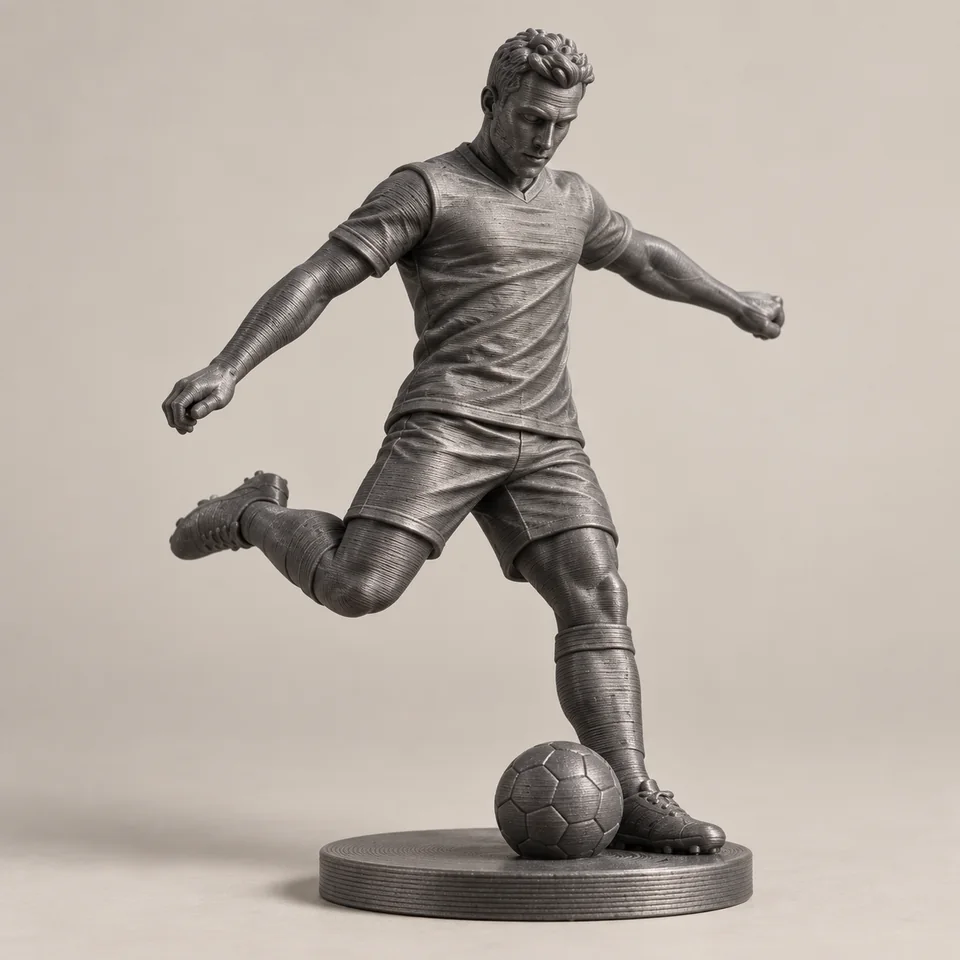
Illustrative Foto3D preview in iron-grey PLA Metal. Not a photograph of a printed figurine; the pose and contact points require a production check.
In a single-colour PLA figure, body position and the shape of equipment carry much of the meaning. The separate colours of a team kit are not reproduced, so the gesture needs to make sense without relying on them.
Choose one instant, rather than the whole action
A photograph freezes a movement that continues in real life. To turn it into a composition, identify the exact moment you want to preserve. A footballer preparing to shoot, making contact with the ball and following through has three different body positions.
Do not automatically choose the most dramatic picture. A familiar stance can be more personal and easier to read than a distant photograph of a jump. Look at the image as though you did not know what happened before or after it. Can you understand the direction of movement and the role of the equipment?
If the memory is about the celebration, say so. That helps prioritise the open arms or the angle of the torso over a secondary detail on the shirt.
Separate the essential gesture from adjustable details
A useful design brief distinguishes what tells the story from what could be adapted. For example, the ball beside a foot and the turn of the torso may be essential, while the precise distance between the shoes could allow some flexibility when preparing the figure.
Airborne poses, small contact areas and widely extended limbs need particular attention when assessing the geometry. A photograph alone does not establish whether the arrangement is printable. Describing the gesture does not require every part to remain in the exact position captured by the camera.
One practical instruction is: “I would like to keep the sense of movement. Any changes to the contact points should be considered without losing the direction of the shot.” This sets a priority for assessing the design; it does not assume a particular technical solution.
Equipment: a few items with a clear purpose
A ball, racket, helmet or backpack can make the scene recognisable. Identify the indispensable object and its position relative to the body. “Racket in the right hand” is more useful than “include all the equipment”.
Thin elements and objects extending away from the subject need consideration during print preparation. Equipment can also be unclear in the photograph itself. Racket strings, straps and small fittings should not be assumed reproducible with the same precision at every size.
If the item mainly identifies the sport, consider whether its overall shape tells the story. If it is central to the memory, explain that importance before assessing the preview.
Choose the reference for the pose
A good portrait may not show the action, while a good action shot may hide the face. Consider which information is missing and describe it. Do not assume the photograph reveals details that are out of sight, such as the far side of the body or an object behind an arm.
When several people appear in the photograph, identify the intended subject by their position or a visible feature. The photo selection guide covers clarity, framing and making the subject easy to understand.
A sample brief for a footballer
“The subject is the person in the middle. I would like to preserve the slight turn of the torso and the ball near the right foot. The important moment is preparing to shoot. Leave out the other players and the background. The kit can be represented through its shape, in the same filament as the rest of the figure.”
Adapt this example to another sport by changing the gesture, equipment and body references. Avoid asking for several incompatible actions in the same composition. One clear scene is easier to assess and refine.
Review the preview as a small sculpture
Look at the silhouette first, then the face, hands and equipment. Is the direction of movement right? Is the accessory on the correct side? Does the pose still make sense when you imagine the figure on a shelf, viewed from a distance?
Our size guide helps you account for the space occupied by extended arms and equipment. The AI preview is illustrative. The estimate model and production file have different purposes, explained in the process guide.
Try your sports photograph in the configurator. Checkout remains in test mode: a simulation does not start real production or dispatch.