A couple figurine from a photo: giving both people space
A couple figurine works when you can recognise two people and the way they relate to each other. Placing two figures on the same base is only the beginning. Their distance apart, the direction of their bodies and the position of their hands give the scene its meaning. For a custom figurine from a photo, settle that relationship before adding clothing details.
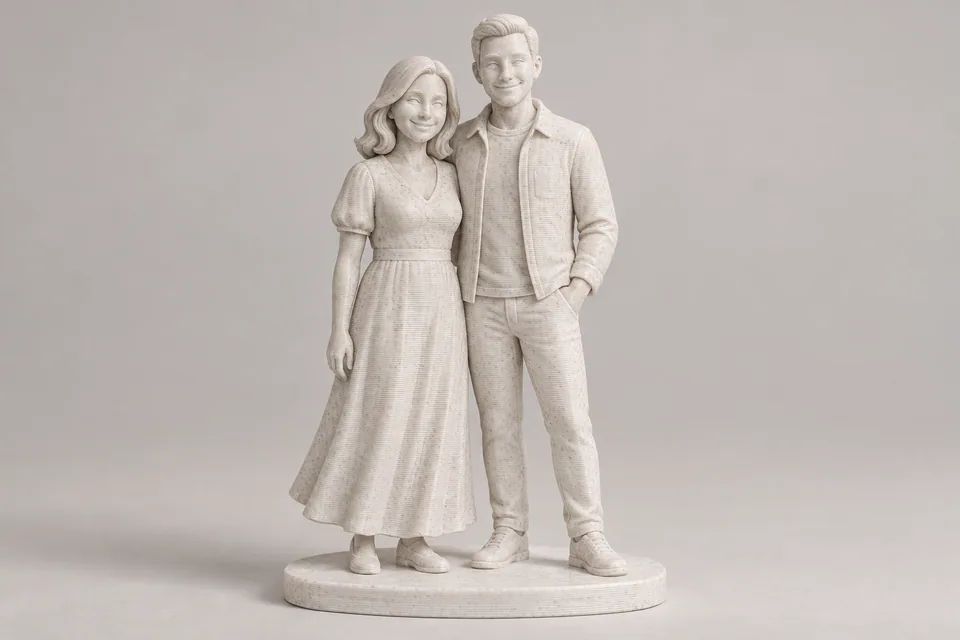
A couple in PLA Marble. Illustrative Foto3D preview, not a photograph of a finished print.

A simple pose can carry the idea. Standing side by side with a hand on a shoulder may express the connection more clearly than an embrace that hides much of both faces. The right choice is the one that preserves your memory; it does not need to be the most elaborate arrangement.
Side by side: a clear view of both people
Two people standing alongside each other provide a straightforward starting point because both can remain visible. Look at their difference in height, the tilt of their heads and the space between their bodies. These relationships help give the pair its character even when small features are simplified.
Decide where the main viewing position will be. If the figurine stands against a wall, a composition that reads clearly from the front may be useful. If it will also be seen from the side, consider whether one person will hide the other from that direction. Our size guide connects these choices with the available display space.
Holding hands or embracing: describe the connection
“Close together” and “embracing” are not interchangeable instructions. Explain which hand rests where, who faces whom and which gesture must remain. You do not need to describe every finger; you need to make the relationship between the two people clear.
Overlapping hands can look like a single shape in a photograph. In the figurine, it matters which arm each hand belongs to. Before choosing that reference, ask whether the gesture is actually visible or whether you understand it mainly because you were there.
A close embrace can conceal clothing or parts of the body. If keeping the embrace matters more than showing the outfits in full, say so. That priority is more useful than asking for every detail to be reproduced exactly.
A shared base: bringing the scene together
A common base can visually unite the scene and establish how the subjects are positioned. Treat it as part of the design: it needs to accommodate the two figures in the chosen arrangement and contributes to the overall dimensions.
Do not assume that a base automatically resolves every question of balance or pose. Contact points, thin parts and projecting elements need assessment when preparing the model. You can ask for a visually unobtrusive base while leaving its feasibility to be checked against the geometry intended for printing.
Avoid filling it with symbols and accessories at the outset. If the shared gesture is the focus, an extra object by the feet may distract from it or make the composition unnecessarily wide.
Use the photograph to explain, not to leave gaps
Choose a reference in which both subjects are clear. If one person is closer to the camera, they may appear larger. Explain the height relationship you want to preserve rather than treating perspective as an accurate measure of their proportions.
If you only have separate photographs, describe the relationship and arrangement you would like. Bringing the people into a new scene involves interpretation; it is different from reproducing a moment already shown in one picture. Use the Formacara contact form for a request that is not clear in the configurator. The photo guide offers more help with references.
A sample brief with clear priorities
“I would like the two people side by side, with the person on the left slightly taller. Keep the hand on the shoulder and both heads facing forwards. Their closeness and the shape of the jackets matter; leave out the glasses they are holding and the background. I would prefer a simple shared base.”
This example separates essential elements from optional ones. Adapt it by making three decisions first: the position of the subjects, the shared gesture and the main viewing direction. Add other personal details after that.
What to check in the preview
Look at each person separately, then at the couple together. Are both included? Does the height relationship make sense? Do the hands belong to the right bodies? Does the gesture retain its intended meaning? Check that an accessory has not been assigned to the wrong person.
The figurine uses a single PLA filament. Both people share that material and colour, with clothing shapes and posture helping distinguish them. The AI preview is illustrative; assessment of the printing model comes later, as the process guide explains.
Plan your couple figurine in the configurator. Checkout is currently in test mode: a simulation does not start real production or delivery.