Original, replica and memory: what does a 3D figurine preserve?
A replica can bring a distant or fragile form within reach. A personal figurine can give an everyday presence to a photograph that otherwise stays on a phone. Both involve making a new object. Its value depends partly on what it makes available, and partly on how clearly it explains its relationship with the source.
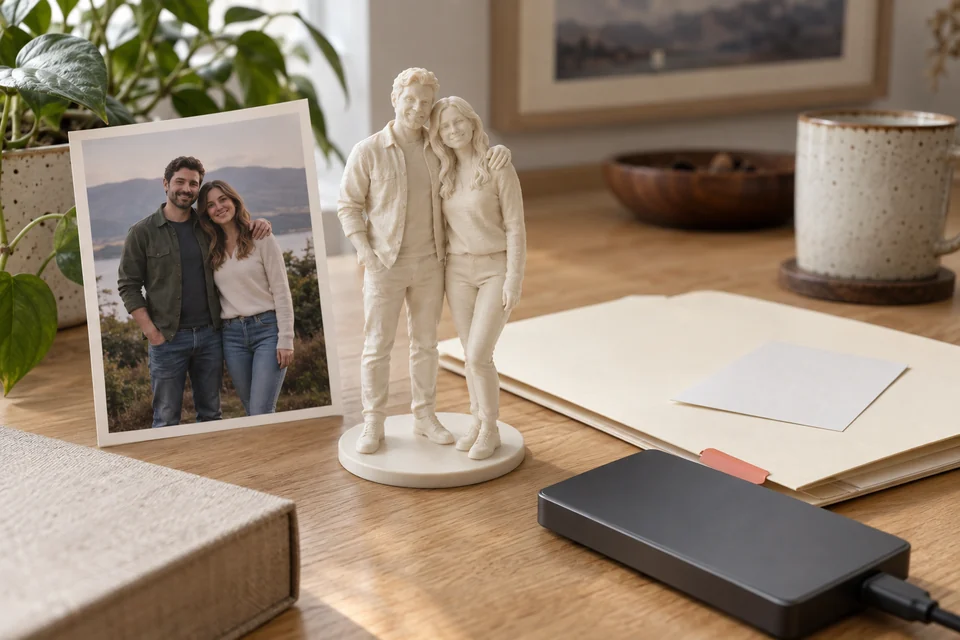
AI-generated editorial composition: photograph, replica and documentation preserve different aspects of a memory. The couple and figurine are fictional, not a documented customer case.
In this guide
Visual resemblance is only one element of that relationship. A replica may follow a surface closely while changing its material. A portrait made from a photograph may retain a familiar pose while interpreting the unseen side. A family figure may become precious because of the dedication or the occasion on which it was given. These are different kinds of value, deserving different descriptions.
This article brings documented digital heritage projects into conversation with straightforward ways of caring for a private memory. It does not equate a commercial figurine with a museum survey. The useful connection is a set of questions: where did the image come from, what changed during the project, which version was chosen, and what information should travel with the finished object? For anyone considering personalised 3D figurines, those questions can help the gift remain meaningful long after it is unwrapped.
Original in relation to what?
The word original needs a reference point. With an existing sculpture, it may mean the physical object from which a replica derives. With a figure designed from photographs, it may mean the first approved design or the first finished piece. The person portrayed is the subject of a new representation, rather than an object being duplicated.
Even an original photograph can mean several things. A camera file, a scan of a paper print and an image received in a message may all depict the same scene, yet carry different information. Each can be useful. Knowing how it reached the project helps explain what it records and which changes may already have occurred.
For a personal commission, it is unhelpful to assume that every later version must be less valuable. A new object begins a history of its own. An anniversary figurine may matter because somebody chose that scene, commissioned the work and wrote the dedication. Its significance does not depend on pretending that its material is identical to another object's material.
The practical question is what relationship the project should preserve. It might be a shape, a gesture, an occasion, a shared activity or a material record. Naming that relationship gives the result a clear purpose. The object can then be appreciated for the connection it sustains, without having to stand for everything about the person or event.
Shape, material and history travel differently
Imagine a reduced replica of a small sculpture. Its outline and many surface relationships may remain recognisable, while its weight, temperature to the touch and response to light change. A change in scale also changes the experience of looking and handling. These differences can be intentional choices suited to the new object's purpose.
Material carries information that shape alone cannot contain. A digital surface may describe a crack. Reproducing that crack in a new material represents a mark on an earlier object; it does not repeat the physical event that caused the damage. The distinction between the copied sign and the history behind it is useful when describing a replica.
Ownership and use also need evidence beyond appearance. A shape does not explain who kept an object, why somebody gave it away or who selected a particular pose. A short, trustworthy note may therefore add more understanding than one more visible detail. It connects the object to circumstances that cannot reliably be read from its surface.
A figure made from a photograph makes this especially clear. It selects a representation of the photographed moment. Keeping the reference photograph alongside the new work allows both to be appreciated: the source as an image with its own history, and the figure as a later interpretation. Neither needs to disappear for the other to have value.
Digital Michelangelo: recorded geometry and presented appearance
Stanford's Digital Michelangelo project, presented at SIGGRAPH 2000, combined scanning and photography. Its project page identifies a rendering of David with artificial veining and reflectance, although the geometry comes from acquisition. Recorded surface and visual presentation are explicitly distinguished. Stanford, Digital Michelangelo.
This is useful because a carefully described presentation can serve a legitimate visual purpose. The viewer is told which aspects belong to the survey and which belong to the rendering. That extra information makes the image easier to interpret without making it less interesting to look at. Explanation and visual quality support each other.
A similar approach works at a much smaller scale. If a preview's colour is a simulation, identify it as such. If the pose follows the reference while the base has been simplified, record that choice. If a marble effect belongs to the selected material rather than to the photographed source, keep those two roles separate.
The useful question is which parts of an image provide evidence for which claims. Convincing illumination can help someone understand a form without documenting the lighting of a real location. A texture can suggest a finish without recording the original material. A precise caption lets each element do the job it is actually equipped to do.
Quality begins with the question the model must answer
Europeana's account of a 2022 European study connects 3D digitisation quality with object complexity, purpose and available resources. Quality is considered in relation to use, rather than reduced to a single ranking by visual detail. Europeana, study of 3D digitisation quality.
A model illustrating an object on a screen has different requirements from one used to compare a surface over time. A replica intended for handling in an educational activity answers another question again. Asking which model is best makes sense only after identifying the job each is supposed to perform.
For a personal figurine, the questions can be quite concrete. Should it be recognisable across a room? Should it preserve the relationship between two people? Is a future reprint part of the service being considered? Different aims make different information valuable: views, measurements, geometry, descriptions or the identity of a particular version.
This also helps decide what to keep. A photograph of the gift with its dedication may document an occasion better than an unexplained working file. A model supplied with permission for future production may have another purpose. These resources can sit alongside one another. The archive becomes more useful when their individual roles are clear.
Smithsonian: access supported by context
The Smithsonian's 3D programme describes applications in research, education and conservation, including work with the data and contextual information that make models understandable. Access to shape is accompanied by attention to its origins and interpretation. Smithsonian 3D, about the programme.
A model on its own can be enjoyable to rotate. A description gives it a more specific identity: what it represents, where it comes from, how it relates to the object and why it was digitised. The viewer can move from an immediate visual impression to an informed understanding of the thing being presented.
A family archive operates in a very different setting, but one question is familiar. A file called final figure tells a future reader little. A note identifying the people and the occasion closes some of the distance between the image and the story that made it worth keeping in the first place.
There is no need to reproduce a museum's volume of documentation. Choose the few facts that no programme can safely recover from the shape: why this gesture mattered, who chose the subject, and what the gift was intended to remember. The most useful addition may be a relationship rather than a more complicated digital model.
The Killer Whale Hat: a replica within an agreed relationship
The Smithsonian documents the Tlingit Dakl’aweidí clan's Killer Whale Hat, repatriated in 2005. Scanning took place with clan permission and supported an educational replica. The object page states that downloads are not authorised at the clan's request. Smithsonian, Killer Whale Hat.
This case gives a concrete distinction between being able to view a form and being free to reuse it for any purpose. A replica can occupy a defined place in an agreement with the people for whom the object matters. Technical reproducibility does not, by itself, determine an appropriate destination for the resulting copy.
For a private keepsake, a proportionate lesson concerns intention and sharing. A family may want a figure at home without wanting the source images published. Someone may welcome a portrait while preferring it to remain associated with a specific occasion. Clarifying the intended audience helps preserve the meaning chosen by the people involved.
The museum case is not an invitation to copy its object commercially or to obtain restricted model data. Its relevance lies in making an often overlooked dimension visible. A replica involves more than a surface: it also involves people who understand its significance and can shape the conditions under which it is used.
The London Charter: making visual decisions understandable
The London Charter's principles connect cultural heritage visualisation with purpose, sources, documentation, sustainability and access. They support understanding a result in relation to the information and decisions behind it. This is a methodological framework for heritage work, rather than a compulsory certification for private gifts. London Charter, principles.
One useful question carries across: could somebody who was not involved in the project understand what they are looking at? If a missing part has been supplied, that should be explainable. If an image presents a hypothetical state, its description should distinguish that from a recorded condition. Clear visual communication can include clear accounts of uncertainty.
For a personal project, a few sentences may be enough. Figure inspired by the selected photograph; unseen back of clothing interpreted; base added; single-colour finish chosen. These are not necessarily details to display prominently on the gift itself. They belong wherever they help someone understand the connection between source and outcome.
Keeping that information does not require publishing private photographs. Documentation and publication are separate decisions. A family can maintain a comprehensible record without opening it to everyone. What matters initially is that the information is connected well enough for the intended readers to follow the project's choices.
Copy, reconstruction and reinterpretation make different promises
A copy identifies a relationship with an existing object or model. A reconstruction may complete unavailable parts using evidence and assumptions. A reinterpretation deliberately changes the subject in pursuit of a new intention. Everyday language allows these terms to overlap, but distinguishing them helps make the commission's aim clearer.
A figure developed from a single photograph usually includes representational decisions. The hidden side, the edge of a base and the move into a single-colour material all involve choices. They are part of how an image becomes an object. Naming them describes the work rather than diminishing the personal character of its result.
Consider two possible projects from one family scene. One retains the shared pose and recognisable clothing. Another turns the subject into a formal bust. Both may become meaningful objects, but they preserve different aspects of the source. A useful description says which qualities were selected instead of relying on the general word faithful.
The article on turning a photograph into a printable 3D model explores observed and inferred information in more detail. Here the concern is how to leave a readable record of those decisions, so that the finished figure's relationship with its source remains understandable after the original conversation has been forgotten.
A memory is not contained entirely in a face
A figurine may be recognisable facially while saying little about the event that inspired the gift. Another may simplify the face yet retain a shared pose that means a great deal to two people. Documentary information and emotional significance can meet in the same object without being identical measures of its success.
It helps to ask which memory should become accessible. A place, an occasion or a short dedication can explain why this subject was selected. They do not need to tell a complete life story. Their task is to link the object to an episode or relationship that might otherwise remain invisible to someone outside it.
Giving the object becomes part of its history too. Who chose the project, for whom, and on what occasion? Those facts belong to the new figure, not only to the photograph behind it. Keeping them allows a later viewer to distinguish the represented moment from the moment when the gift was made.
Those moments may have different dates. A photograph taken many years ago can inspire a figurine today. Recording one year without explanation can blur the event, the photograph and the production. A short description protects the relationship between them more effectively than an apparently precise but ambiguous date.
A short personal record with a clear purpose
A useful record can begin with the subject, the occasion represented and the source selected. Add the date of the project or delivery, the stated material and the dimensions. Where information is unknown, mark it as unknown. An incomplete but accurate record is easier to trust than a polished account filled with assumptions.
A second part can describe the major changes: clothing simplified, background removed, an accessory added or a posture adapted. Include what helps interpret the figure. There is no need to record every software operation, every abandoned draft or the whole exchange through which the project developed.
A third part can identify the approved preview and photographs of the completed piece. This prevents an earlier proposal from being mistaken for the delivered object. If model files have been supplied, describe their stated purpose: viewing, keeping as a record or future production, according to what was actually included.
Finally, note the intended audience for sharing. Keeping something within a household, sending it to relatives and publishing it are different choices. Unrelated sensitive information adds little to the record. Addresses, identification documents and details with no bearing on the memory need not be gathered into the figurine's story.
Keep the source without overwriting it
The Library of Congress guidance on personal digital photographs recommends identifying important images, organising and describing them, and maintaining managed copies. An archive involves selection and care as well as storage. Library of Congress, personal digital photographs.
For a photo-based project, a simple approach is to separate the image as received from edited versions. A crop that helps a modeller inspect the face need not replace the full photograph. A brightened image may improve visibility, while the earlier version records the starting point. Keeping their roles distinct avoids confusion later.
Plain file names can help: reference photograph, face detail, approved preview, finished figurine. A technically perfect naming system is less important than being able to recognise a file's job without opening ten alternatives. When a date appears in a name, explain whether it refers to the event, the image or the project.
A picture received through a message may still be a useful source. Its description can simply say received from a relative, date of photograph unknown. If an original camera file exists elsewhere, that is a different resource. Honest modesty about provenance is more useful than assigning an exact origin that nobody can confirm.
Organise a small archive around questions
Instead of grouping everything only by file extension, arrange the material by function. One group holds sources: photographs and identification notes. Another holds the chosen design and a brief account of changes. A third holds the result: photographs of the piece, its material and its size. An optional fourth contains supplied files for later uses.
This organisation answers practical questions. Which image started the project? What was approved? What was actually made? Which resources are available for further work? Someone unfamiliar with the original commission can find their way without reconstructing the entire message history or knowing the software used to make the figure.
A short index kept beside the files can describe the groups and explain dates. When the folder is copied or handed to another person, the index travels with it. Information left only in a separate conversation can be harder to locate and harder to connect to the correct version years later.
The collection need not include every image generated during the project. Ten nearly identical alternatives may obscure the chosen result. Keeping the source, a few significant decisions and the final version can be enough. Other stages earn their place when they explain something worth remembering about how the object came to be.
Openable today and understandable tomorrow
A file can exist without being convenient to use. A photograph may open in an ordinary viewer, while a working 3D project may depend on particular applications or additional information. The Library of Congress examines digital formats partly through their preservation and access characteristics. Library of Congress, digital formats.
For a personal collection, begin with the intended use. An easily viewed photograph documents appearance. A working file may retain editing possibilities while bringing dependencies of its own. A production-oriented model may need units, scale and component information. These resources can complement each other because they preserve different capabilities.
If a model is included in the service, check that it opens when received and keep the accompanying information. If it is not supplied, record what you actually have rather than assuming a model is included or will remain available indefinitely. The archive should describe its real contents, not a hoped-for future delivery.
For a future relative, an ordinary image and a clear description may be more immediately useful than a specialist format. For future manufacture, other resources may be needed. Making these differences visible is part of organising the collection; the generic label 3D file leaves too many practical questions unanswered.
Integrity, access and meaning need separate checks
A file may be identical to the copy originally saved yet difficult to open in a changed environment. It may open correctly but show a version that nobody can identify. A detailed description may survive while the file it refers to has disappeared. Each situation points to a different aspect of keeping digital material usable.
Integrity concerns whether the data have changed. Access concerns whether people can consult them. Meaning concerns whether their contents and origins can be understood. A small private collection does not require elaborate tools to begin checking these things: opening the important files and reading the index already tests something concrete.
When copying a collection to another location, check that the expected groups are present and that the principal images open. The existence of a folder tells you little about whether every intended item arrived. Notes and any relevant information about permitted use should remain connected to the project they describe.
The frequency of checking can reflect the importance of the memory and the tools being used. The aim is a manageable habit, rather than a promise of permanence. Digital preservation depends on people making and revisiting choices as well as on the devices that happen to hold the files.
Extra copies without extra confusion
An additional copy is useful when its contents and location are known. Folders called latest, new and definitely final can instead create uncertainty about the version worth keeping. Before duplicating material, decide which collection is the reference set and which copies are intended simply for viewing or sharing.
The core can remain small: selected source, personal record, approved preview and photographs of the result. Add any supplied files intended for later use with a description of their role. Keeping the same structure in another copy makes comparisons easier and gives someone else a recognisable route through the collection.
Think about access as well as location. If everything depends on one person's account, somebody who later inherits the keepsake may have no idea where to look. Public sharing is unnecessary; the question is which trusted people should be able to find the materials and what information they will need to do so.
These are organisational suggestions for a private archive. They do not imply permanent hosting, file recovery or automatic model delivery by Formacara. Establish what the chosen service actually provides, and keep the family record clear about which resources are held independently of the supplier. That distinction makes future decisions easier.
Preserve for a reason, rather than keeping every duplicate
In March 2026 the NDSA published version 2.1 of its Levels of Digital Preservation, including environmental sustainability considerations. The framework addresses preservation decisions and resources; it is not a set of compulsory instructions for private collectors. NDSA, version 2.1 announcement.
The useful private-scale analogy is deliberate selection. The source and the final result have clear jobs. Dozens of temporary exports may contribute little if they do not explain a significant decision. Removing confusion is compatible with preserving a history when the selection is guided by what makes that history understandable.
It is easier to make those choices while the project remains familiar. A note can explain why a version is retained: first proposal, important revision or approval. Other material can be handled according to personal preferences without treating every intermediate operation as a permanent item in a growing collection.
A smaller, clearer archive can be easier to inspect, copy and pass on. Its usefulness depends partly on whether someone can navigate it. Storage capacity alone is a poor measure of how well a collection serves the people who may eventually need it or wish to understand its significance.
A modest application of the FAIR principles
The FAIR principles were formulated for scientific data: findability, accessibility, interoperability and reusability. They concern making data understandable and usable, rather than requiring private images to be published. Wilkinson and colleagues, FAIR Guiding Principles.
For a figurine's small archive, we can adapt the questions informally. Can I find the folder? Do the intended readers know how to access it? Can the important files be opened using available tools? Do the notes explain their intended uses? This is our practical analogy, not an assessment of formal compliance.
Findability may depend on a sensible name. Access may be restricted to family. Consultation may be helped by ordinary images alongside specialist files. Where reuse is provided for, the received information and conditions can describe it. None of these choices requires placing a person's face or a family's private history on a public website.
The framework is useful because it separates problems often hidden inside the word saved. A saved file that cannot be found, or one that can be found but no longer understood, is not fully serving its intended purpose. Addressing those problems need not make a personal collection complicated.
Sharing a memory is a separate decision
Someone receiving a figurine may want to show it to friends while keeping the reference photographs private. Another person may prefer to share the finished object without its dedication. Separating materials by function makes these choices possible without automatically exposing every part of the project to the same audience.
Before publishing, agree with the people portrayed which images and details to use. A photograph selected for a family gift need not become a public example simply because it is available. Names, dates and personal details may have an intended audience different from that of a photograph of the finished figure.
A simple approach is to prepare a separate sharing copy. The private collection remains complete, while the outgoing folder contains only the material selected for that audience. This keeps the source intact and reduces the chance that an unrelated image or note travels with the item somebody actually meant to send.
External artworks and model collections also come with individual conditions. Being able to view something online is not, by itself, permission to manufacture, alter or use it commercially. The Tlingit hat case makes that distinction tangible, while reminding us to read the conditions attached to the particular content rather than assuming one rule covers every collection.
Three personal scenarios and the records they need
In the first illustrative scenario, a couple chooses a figure for an anniversary. The photograph depicts their wedding many years earlier; the figurine is made now. The record distinguishes the event, the project and the occasion of the gift. It preserves the chosen photograph and approved design, helping future viewers understand what the year on the base refers to.
In the second scenario, a family wants to remember a grandfather from a partially cropped photograph. The back of his jacket and one hand are unseen. The design retains his pose and clothing while completing the hidden areas. A short note records those interpretations and keeps the full source image, so that a later viewer can recognise the difference between photographic evidence and a plausible addition.
In the third scenario, a person commissions a figure with an accessory connected to their profession. A later version changes the accessory to mark a different role. Both versions can be worth keeping, each for a distinct reason. Their photographs and files receive names that identify the stage represented, allowing the later object to add to the story without erasing the earlier one.
These examples are hypothetical, not accounts of actual customers or guaranteed services. Their point is that a proportionate record can preserve a few reliable relationships: source and interpretation, event and manufacture, first version and later revision. A domestic keepsake does not require a museum inventory to benefit from that clarity.
The physical figure has a life of its own
An object on display becomes part of everyday life. It is moved, lit, cleaned and seen from familiar places. Caring for the physical piece is a different activity from caring for its files. A digital record and a well-kept object support different aspects of the memory, and both can deserve attention.
Record the actual material. A marble, wood or metal effect describes an appearance; it does not turn PLA into stone or solid metal. Clear material information helps explain what the object is and supports appropriate care. The article on 3D printed PLA figurines discusses material characteristics and the choices behind the finished appearance.
An initial photograph can document the piece as delivered. If it is later repaired or altered, a short note can distinguish the new condition. Every small change does not need a dossier. Record the changes likely to affect how another person interprets the object or understands the choices made during its life.
The memory can therefore include the figurine's own history, as well as the person or event it represents. Where a gift was kept and who cared for it may become meaningful. That value belongs to the object's relationships with people; it does not need to be presented as a technical characteristic of the material.
From public history to a private keepsake
Museums work with responsibilities, collections and methods different from those of a family. Their projects offer ways to ask better questions: what do we know, how do we know it, and how can we explain it to someone who was not there? Those questions are useful at a smaller scale without turning a private gift into certified heritage.
Our account of ancient figurines and their meanings shows how context changes the reading of apparently familiar figures. A private description performs a smaller but concrete task. It keeps the connection between an object and its occasion, so that its meaning does not have to be guessed entirely from its shape.
If you are beginning a new project, the page on a custom figurine from a photo introduces that service. A decision about the memory can come before a decision about format: what should the object make present, which sources are available, and what would you like someone else to know about the choice?
A brief, precise answer is already a useful start. The new object does not have to preserve everything to matter. It can preserve something recognisable while making its relationship with the person, the photograph and the chosen moment clear enough to remain meaningful beyond the original commission.
A sample description with clear relationships
An illustrative record might begin: figure of two people inspired by a family photograph; made as an anniversary gift; date of the photograph unknown. That introduction identifies the subject, source and occasion without manufacturing precision. The private version may name the people, while a shared version uses a more general description suited to its audience.
A second paragraph could explain the interpretation: background excluded; pose retained; unseen backs of clothing interpreted; base and dedication added. This describes the work connecting a two-dimensional image to a new object. It gives future readers a way to understand which decisions belong to the project rather than to the photographed scene.
The next part records the outcome: material and dimensions as supplied, a linked photograph of the finished piece, and an identified approved preview. If the weight was never measured, it need not be guessed. If no model file was delivered, the record should not list one as available. Describe the resources that actually exist in the collection.
Finally, a personal sentence can explain why the pose was chosen: it recalls something the two people used to do together. That memory can remain private. Its role is different from a statement about production or material. It preserves the voice of the person who wanted the object, alongside the facts that describe what was made.
Frequently asked questions
Is a replica less valuable because it is not the original?
Its value depends partly on its purpose. A replica can make a form accessible, support an explanation or become a personal keepsake. Its material and history are distinct from those of its source. Describing what it preserves helps it be appreciated for the contribution it actually makes.
Should every project file be kept?
A clear core may be sufficient: selected source, personal record, approved preview and photographs of the finished piece. Add any supplied models with an explanation of their purpose. Intermediate versions are useful when they document a meaningful choice, rather than simply because they happen to exist.
Does keeping digital files guarantee a future reprint?
That depends on the available files, their conditions of use and the work required for a future process. A photograph records appearance, whereas manufacture may require geometry and checks. Clarify any reprint provision with the service instead of assuming it follows from having seen a preview.
Can a generated image belong in the archive?
Yes, when its role is identified. It may record a concept or a presentation choice. Keep it distinct from the reference photograph and photographs of the physical piece. A clear label allows it to remain part of the project's history without being mistaken for evidence of the delivered object.
Which information is easiest to forget?
Often it is the reason for the choice: why that pose, who wanted the gift and which occasion it remembers. Facts obvious to the original participants may be less apparent later. A few trustworthy sentences kept with the object and its images can help that understanding survive.