From a photo to a printable 3D model: information, decisions and checks
A photograph, an image of a proposed figurine and a production file may look like successive versions of the same thing. They contain different kinds of information. A photograph records a view. A simulation proposes an appearance. A navigable representation lets the viewer change position. Physical production requires geometry and decisions appropriate to a material, size and manufacturing process.
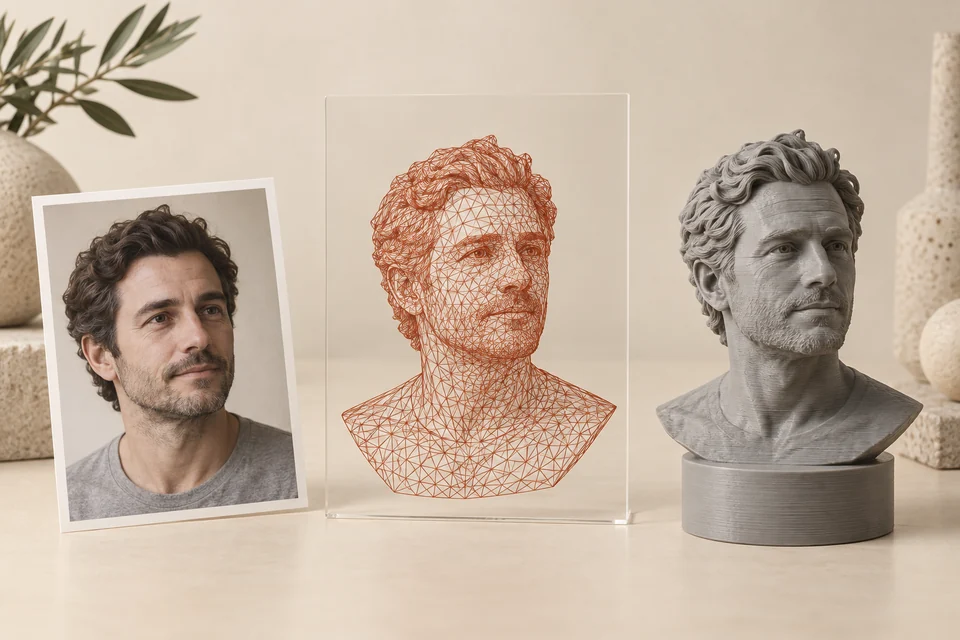
AI-generated conceptual illustration: an image, a surface and a printable object are different representations. It does not document a measured reconstruction or guarantee this result from a single photo.
In this guide
The distinction becomes especially important when the starting point is one photograph. We see a face, jacket and hand at the front. We may not know how the hairstyle continues behind the head, what the back of a backpack looks like or where an obscured arm goes. The project must resolve those absences. A convincing resolution is still different from a measurement of the hidden area.
This guide explains the journey from the perspective of someone reviewing a proposal for personalised 3D figurines. The research methods cited help distinguish representations; they are not a description of Formacara's internal workflow. The practical framework has three categories: observed information, inferred parts and deliberate design changes. Keeping them visible makes approval more concrete and helps direct questions towards the parts that matter.
A photograph does not contain every view
The first limitation is geometric. A surface facing the camera can hide another surface. If a person keeps one hand behind their back, the fingers remain unseen. If a coat covers the torso, its underlying form is not directly visible. Increasing the resolution of the same picture does not remove that absence.
A sharp photograph can provide better information about visible details. It does not create a new viewing position. Enlarging a front view of a head will not reveal its rear profile. This difference between detail and coverage is fundamental: a larger file is not always the answer to the question the model needs to resolve.
Even an outline can be ambiguous. A dark region beside an arm might belong to clothing, shadow or background. Our perception often settles the ambiguity through familiarity with bodies and objects. Reconstruction turns that interpretation into a spatial decision, which becomes apparent when the figure is rotated.
The useful request is to distinguish parts that must remain faithful to known information from parts that can be interpreted. If the back of a coat is unimportant, a simple completion may be appropriate. If it contains a characteristic feature, another reference or an explicit design decision becomes valuable. This directs effort towards uncertainty that affects the intended portrait.
Three labels for the origin of a feature
An observed element is documented in the available references: the visible shape of a collar, for example. An inferred element supplies a plausible solution for something not shown, such as the continuation of fabric behind a shoulder. A designed element is an intentional addition or alteration, such as a base absent from the photographed scene.
All three can exist within one object. An arm may follow an observed pose, a partly hidden hand may be completed through interpretation, and contact with an accessory may be adjusted for the physical project. Calling everything reconstruction makes it harder to understand what has actually been selected.
A short description can be enough: face based on the selected photographs; back of jacket simplified; base added; gap between two elements adjusted. The customer need not become a technician. They need names for decisions that could change the figure's meaning or appearance.
This distinction remains useful when a proposal looks excellent. Visual quality can conceal uncertainty about a detail's origin. Someone who knows the subject may correct that detail more effectively than someone working only from pictures. The preview then becomes a shared verification stage, rather than apparent proof that all information was already present in the original image.
Perspective and physical proportion are different things
In a photograph, parts closer to the camera can appear larger than parts farther away. An extended hand may occupy substantial image space without being unusually large on the real person. A close facial view can show different apparent relationships from a more distant one. Copying dimensions across the picture plane is therefore different from recovering dimensions in space.
Consider a couple with one person standing slightly forward. That person may look relatively taller or larger in the frame. Before fixing the figurine's proportions, decide whether the aim is to preserve the photographic effect or represent the people's relative sizes. These are different intentions, both of which can be described clearly.
Accessories create similar questions. A ball near the lens may seem enormous beside the torso. A bag seen at an angle may look compressed. An adjustment should refer to the chosen pose, available evidence and the commissioner's knowledge, rather than a vague idea of what looks normal.
Where available, genuinely different views help identify which differences belong to perspective and which belong to the subject. Each should have a purpose. The shorter guide to choosing a photo for a custom figurine covers practical reference selection. Here the key issue is understanding what each photograph can help establish.
More pictures help when they add information
Ten nearly identical views may reveal less new shape than one useful side view. A profile can clarify what the front leaves uncertain. A rear photograph can answer a specific question about clothing. The criterion is new information, not merely the number of files supplied.
Consistency matters too. Images taken on different days may show different hairstyles, expressions or outfits. They can be useful for an interpretive portrait when the intended version is chosen explicitly. For automatic geometric reconstruction, a changing subject presents a different problem from a stationary object photographed repeatedly.
Assigning roles helps: one picture for the face, another for profile, another for clothing and another for pose. This does not turn a family album into a metric survey. It prevents accidental contradictions. If two photographs show different glasses, make a choice. If the hand is hidden in every picture, the gap remains.
Requests for additional references should therefore be targeted. “A view showing how the arm passes behind the body” is clearer than “send more photos”. The first identifies an uncertainty. The second can produce many extra files without resolving the decision that matters.
A good reference set also makes disagreement easier to discuss. If a revision follows the wrong hairstyle, the chosen source can be identified immediately. The conversation moves from competing impressions towards a specific relationship between evidence and result.
Photogrammetry: comparing observations of the same subject
COLMAP's documentation distinguishes initial recovery of structure and camera positions from later dense reconstruction and surface creation. It calls for overlapping photographs from different positions; turning a camera while remaining in one place is different from moving around the object. Official COLMAP tutorial.
The useful principle is comparison between observations. A feature appearing in several pictures supplies relationships that a single picture cannot provide. A collection of images may nevertheless leave areas unseen, difficult to distinguish or inconsistent. Those parts require attention during interpretation and review.
Schönberger and Frahm's Structure-from-Motion Revisited, presented at CVPR in 2016, is a research reference for this kind of reconstruction. It describes a methodological contribution, rather than a guaranteed outcome for every set of customer photographs. CVPR paper.
For someone reviewing a proposed figure, ask which areas are supported by multiple observations and which were completed afterwards. A high photograph count alone is less informative than knowing what those photographs actually cover. The resulting surface also needs to be assessed for its final purpose, rather than accepted solely because a reconstruction stage produced it.
A helpful analogy is comparing several witnesses to one arrangement. Agreement can constrain an explanation, but missing testimony still leaves questions. The analogy is about information, not about treating an algorithm as a human observer. It highlights why coverage and consistency matter together.
Generation from one image: plausible is different from observed
The 2023 Zero-1-to-3 research explores new-view generation from a single RGB image using learned diffusion-model priors. It demonstrates how views absent from the source can be proposed. Hidden regions are consequently inferred rather than directly measured. Liu and colleagues, Zero-1-to-3.
Imagine a jacket visible only from the front. A generated rear view may be convincing because it resembles a plausible jacket. It might still add a seam that the actual garment does not have or choose the wrong length. Visual coherence and correspondence with that particular jacket are separate criteria.
An interpreted area may be entirely acceptable in a decorative figure. What matters is whether it touches a priority. The unseen rear of a minor shoe detail may be unimportant, while a recognisable hairstyle could be central. Uncertainties deserve different amounts of attention according to their effect on the project.
The most useful review therefore occurs where uncertainty meets importance. The aim is not to eliminate every inference, which is unrealistic for many single-photo projects. It is to avoid treating an automatically proposed feature as documented information about the person.
The commissioner can contribute by identifying meaningful errors rather than requesting more detail everywhere. “The back of this coat should be plain” resolves a specific question. “Make the image more realistic” might produce a more polished version of the same incorrect seam.
Four-view images are not automatically one model
Four images may show the proposed front, back and sides. That makes certain visual choices clearer, but the pictures alone do not establish a single consistent geometry behind them. They might have been produced separately or contain differences visible only through comparison.
Check recognisable relationships: the number and position of accessories, how a hand holds an object, the continuity of clothing and the relative heights of people. If a ball changes sides, a pocket appears and disappears, or two supposedly different views face the same direction, the presentation leaves an unresolved question.
This review requires no specialist software knowledge. It requires comparing relationships instead of relying only on overall appeal. Attractive pictures can be useful concepts. Consistent pictures can make a concept more explicit. Availability of a navigable three-dimensional model is an additional property to verify separately.
The same applies to a rotating video. Smooth apparent movement can be simulated. Ask what the footage represents: a visual concept, the actual model, or a recording of the physical result. Each can serve a useful purpose when its role is clear.
One practical habit is to follow a single feature around the proposed views. Track a strap from shoulder to back or a sleeve from upper arm to wrist. This often reveals continuity questions more effectively than repeatedly judging whether the entire picture looks convincing.
NeRF: producing views and producing a solid answer different questions
The original Neural Radiance Fields, or NeRF, research describes a volumetric representation for synthesising new views of a scene. A compelling visual experience does not by itself establish a solid prepared for manufacturing. Mildenhall and colleagues, NeRF.
That distinction is not a criticism of the method. A representation can be excellent for looking at a scene and require further work for a different purpose. A high-quality photograph is not a defective audio file because it lacks sound. It answers another question. Successful view synthesis and physical fabrication likewise involve different criteria.
It would be inaccurate to claim that geometry can never be obtained from these approaches. Methods and further developments serve different goals. For a commission, the practical questions remain specific: what geometry will be used, how are incomplete areas treated, and which version has been checked?
Keeping navigable and printable as separate terms avoids confusion. The first describes a viewing experience. The second should refer to a defined object, scale and process. A presentation can communicate the former beautifully while still leaving decisions about the latter to be made.
Gaussian Splatting: another way to represent appearance
Kerbl and colleagues' 2023 3D Gaussian Splatting for Real-Time Radiance Field Rendering represents scenes using Gaussians to generate views. Rendering quality and an available manufacturing surface remain separate issues. Inria research project.
A presentation may aim to let someone recognise a scene while changing viewpoint. A physical figurine also needs decisions about where material ends, which parts touch and which remain separate. A fluid visual experience can be successful before those manufacturing relationships have been settled.
Method names can describe a project usefully, but they should not replace assessment of its output. A customer does not need to choose a technology simply because it appears in recent research. They need to understand what they receive and which use has been verified.
It is therefore more informative to ask whether a solid model has been checked at the final size than to ask generally whether a service uses AI, scanning or an advanced technique. The technological label alone says little about completeness, individual correspondence or production readiness.
For comparison, imagine two proposals showing the same coat convincingly. One supplies a visual representation for viewing; another supplies a checked surface for fabrication. Their pictures may look similar while their practical uses differ. The distinction concerns the delivered information, not which image looks more impressive.
A mesh is an organised surface
A mesh describes a surface through connected elements. In a figurine, it may define the head, body, clothing and accessories. More elements do not automatically mean a better portrait. A highly detailed surface can include noise, while a simpler one can preserve essential shape well.
Polygon count is therefore technical information rather than a universal measure of likeness. If a jaw is the wrong shape, dividing it into many triangles does not correct it. If a button is irrelevant at the selected scale, describing it with many elements may increase file size without improving the customer's experience.
Ask where useful information is concentrated. Areas central to recognition need to retain their form; secondary areas may be simplified thoughtfully. Reducing complexity should be assessed against the features the project must preserve, not only the amount of storage saved.
Unseen surfaces can also matter technically. A model that looks good in a viewer may contain overlapping parts, open surfaces or separate elements. Aesthetic review and structural file review therefore have different jobs. Both contribute to the final project.
For a customer, this does not mean demanding a mesh inspection report for every decorative detail. It means understanding why a polished screenshot and a production check are not interchangeable, and why a visibly simple change may require work beyond the view being shown.
STL and 3MF: a file extension is not a certificate
The Library of Congress describes STL as a triangular surface format without standard support for colour and texture. An STL can contain useful production geometry, but its name does not establish that the particular content is complete or suitable. Library of Congress, STL.
The 3MF specification provides for explicit units, objects, components and associated information. These capabilities can clarify an exchange, while the actual export and its interpretation still need checking. 3MF Consortium, Core specification.
Think of a document format that supports headings and images. That capability does not guarantee accurate prose. A 3D file can likewise open successfully while representing an outdated version, using an unexpected scale or losing a component during transfer between applications.
Before requesting a format, clarify the intended use: viewing, later editing or production. Also check whether file delivery is included in the service. The existence of a model used internally does not automatically mean the customer receives an editable copy.
The most useful delivery description names the intended purpose as well as the format. “A model for viewing” and “a model checked for this production process at this size” communicate substantially different things. Neither description should be replaced by the word 3D alone.
Dimensions and units: a checkable example
Suppose, purely as a numerical example, that a digital figure is 200 millimetres tall and is reduced to 100 millimetres. The linear scale factor is one half. A part 2 millimetres wide becomes 1 millimetre wide under uniform scaling. This calculation does not decide printability; it explains why changing height affects details throughout the object.
If the base is included in total height, the body occupies less of that measurement than when height refers only to the person. A tall hat creates another distinction. A dimension should state what it measures: bottom of base to highest point, or another explicitly agreed distance.
Units must remain consistent through transfers. A number without a clear interpretation can lead to a very different object. The customer does not need every detail of a file format explained. They need understandable final dimensions associated with the approved version.
Scale should not be changed at the end without reconsideration. When a design becomes smaller, visual priorities and some construction conditions need checking again. A model suitable at one size is not automatically equivalent at every other size.
Length, area and volume change differently
A mathematical example makes the distinction concrete. A cube with sides of 20 millimetres has a geometric volume of 8,000 cubic millimetres. A cube with sides of 10 millimetres has a volume of 1,000. Halving every length reduces volume to one eighth. Surface area falls from 2,400 to 600 square millimetres, or one quarter. These are scale relationships, not estimates of production time or material use.
For a figure, a finger's thickness, strap width and connecting element's diameter change linearly under uniform scaling. Enclosed geometric volume changes with the cube of the factor. The physical result then depends on how the object is made. Weight and printing time cannot simply be read from the volume comparison.
Imagine an accessory 4 millimetres wide in the larger version becoming 2 millimetres wide in the smaller one. We have not established whether it will be clear or robust. We have identified a precise question: does it remain appropriate for its role at the new size? Possible decisions include retaining it, adjusting it locally or reconsidering overall scale.
A local adjustment departs from perfectly uniform reduction. If the body is halved while a feature remains proportionally thicker, that is a design adaptation. It can be appropriate, but should not be described as identical reproduction of every relationship. This matters especially near the face or around gaps that define a pose.
The customer can understand the decision without a long parameter list. Identify which parts were adapted after size selection and show them in relevant views. Final size then becomes a decision running through the project, rather than a number appended after everything else has been approved.
Correct geometry and a producible object are different thresholds
Prusa's design guidance discusses solid geometry, thin details, orientation and tolerances in relation to printing. These are process-dependent checks rather than one universal threshold for every figure, material and setup. Prusa, modelling with printing in mind.
A closed surface can still describe a feature too delicate for its intended role. An element may be producible but difficult to finish without damage. A pose can look stable on a screen because the screen does not physically support it. Review therefore moves from mathematical description towards the actual object.
The customer need not solve these issues alone. They should be able to recognise when a technical adaptation changes an important appearance. A connection added between arm and torso might be discreet or might change the silhouette considerably. Its necessity and its visual effect need to be considered together.
For material, layers, supports and care, see the guide to 3D-printed PLA figurines. Here the concern is the transition between decisions: an attractive view completes one kind of assessment, and a correct file completes another. Physical production introduces further conditions.
Photographic colour and physical relief
A shirt may contain a printed number, a raised seam and a shadow. All three produce visible variation in the photograph, but they describe different things geometrically. The number may exist only in colour, the seam may have physical thickness, and the shadow may correspond to no mark on the surface at all.
Turning every contrast into relief would create arbitrary form. Ignoring every contrast could remove meaningful information. Decide which features should be represented physically and which belong to image colour. The choice is particularly evident in a single-colour figurine.
A coloured preview can display a shirt number clearly even when the underlying surface does not contain it. If the intended figure is monochrome, a view with a uniform material helps reveal what remains legible as shape. It answers a question that the texture may otherwise conceal.
Eyes and eyebrows raise similar issues. Colour contributes strongly to recognition in a photograph, while the model must decide how to represent form. A visible feature in a preview image and a corresponding feature in the produced surface should be checked as separate pieces of information.
This is also why changing a preview from colour to one material can feel more substantial than selecting a different finish. The change reveals which aspects were carried by surface appearance and which were carried by geometry. It can be a productive review stage rather than a disappointing surprise.
An illustrative case: the ball beside the arm
Imagine a sporting figure with a ball near the hip. In the photograph, ball and arm appear to touch. A side view might reveal a gap or confirm contact. Without that view, the project has to choose how to resolve the relationship.
One proposal could keep the elements separate. Another could introduce a discreet connection. A third could move the ball slightly. These are not merely technical settings: they change the empty space, readability of the action and potentially the physical arrangement's stability.
The useful review question is whether contact was observed, inferred or designed. If the ball is central to the pose, the adaptation should be visible in a relevant preview. A frontal image might conceal it, whereas a three-quarter or side view can clarify it immediately.
This is a teaching example, not an actual order or reported test. It demonstrates how a small photographic ambiguity becomes a concrete spatial decision. Asking for more detail would not resolve it, because the uncertainty concerns a relationship rather than surface complexity.
The commissioner can then state a meaningful priority: retain the ball's position even if another discreet connection is needed, or preserve a clear gap even if the arrangement must change. Such choices are more useful than approving an attractive front view while leaving the spatial issue unstated.
A second case: two people and a hidden hand
In a couple's photograph, one hand may disappear behind the other person's body. The scene looks natural because the photograph need not expose what is hidden. In a model, the hand can be completed, simplified or kept largely concealed, but its relationship with the arm and body still needs a decision.
The first check concerns continuity: does the arm clearly belong to the correct person? The second concerns the gesture: does the position still convey the intended embrace? The third concerns viewing: does the solution remain credible from the side? These questions differ from recognising the two faces.
A proposal can work aesthetically without being a certain reconstruction of the original hand. Another photograph of the same pose may reduce uncertainty. Without one, judge the completion by coherence and relevance, while describing it honestly as interpretation.
Separating categories simplifies the discussion. Correcting an observed pose and expressing a preference about a hidden completion are different requests. Treating them as identical can create unrealistic expectations about what the references establish.
A useful annotation might identify the visible upper arm as fixed and the hidden hand position as open to interpretation. That small distinction can prevent unnecessary changes to the whole pose when only the concealed part needs a solution.
A third case: an important but incomplete old photograph
A family photograph may be blurred, cropped or the only surviving reference. Its emotional value does not depend on technical quality. Difficulty arises when processing is expected to recover precise information that the image no longer records clearly.
The project can concentrate on dependable features: the broad pose, type of clothing or relationship between people. Other details may need additional references or an acknowledged simplification. This does not diminish the memory. It distinguishes a new interpretation from documentary evidence of the past.
Image enhancement can make some outlines easier to read, but reconstructed detail remains something to assess. A highly defined face generated from a weak source can feel persuasive because it is complete. Visual completeness and original information content should be considered separately.
An interpretive figure may be exactly the right choice for a personal keepsake. The project description should reflect that choice, and those involved should understand which parts preserve available evidence and which parts are newly supplied.
For example, retaining a characteristic seated posture and coat may carry the memory more effectively than inventing fine facial detail. Another family may consider the face indispensable and prefer to wait for better references. The appropriate decision depends on the intended meaning, rather than a universal rule about old photographs.
What can be checked without opening 3D software?
Begin with project identity: number of people, pose, principal accessories, clothing and gaze direction. Then check consistency between views. An object should remain on the same side, an arm should continue coherently and a detail should not disappear without explanation. Finally, check the declared dimensions and what they include.
A few direct questions can organise the review. Is this the version intended for production? Do these pictures show the actual model or an illustrative proposal? Which regions were absent from the references? Are manufacturing adaptations already included? Does the shown material correspond to the intended appearance or merely to presentation lighting?
These questions do not require disclosure of every internal step. They clarify the object of the customer's decision. Answers can be brief as long as they distinguish stages. The existence of a solid production model should not have to be inferred from the polish of an image.
For starting a project, the page about a custom figurine from a photo explains the service. The technologies discussed here provide a framework for understanding; they are not a list of features automatically included in every commission.
Version control: the right model in the wrong picture
When several proposals exist, identifying the version matters as much as its content. A generic filename such as final can be reused. A revised view can accidentally appear beside an older one. The result may be approval of a combination of features that exists in no single model.
A set of views should therefore refer to one identifiable version. If a revision changes the face, pose or base, the relevant pictures should reflect it consistently. The customer need not retain dozens of intermediate steps. They need to know which set represents the current decision.
Scale belongs to that version too. A model approved at one height and subsequently reduced introduces a new practical decision. Important parts deserve another look at the revised size. A material or finish change likewise deserves attention where it affects the intended appearance.
A short approval note can record version, dimensions, subject and agreed adaptations. It is not a universal technical certificate. It makes the decision about what the images show easier to verify.
If a new preview looks different, compare it with the requested change before reopening every earlier choice. A camera or lighting adjustment can affect appearance without changing geometry. Conversely, a subtle geometric alteration can matter even when the overall presentation looks almost identical.
Where the model ends and the physical object begins
The file does not automatically contain the history of its manufacture. Process selection, preparation, making and finishing introduce conditions that an ideal visualisation does not reproduce completely. A photograph of a real print therefore has a different evidential role from a rendering.
The rendering can make intended shape clear, including views difficult to photograph. The photograph shows a particular physical result with a surface, lighting and finishing state. Both are useful when identified correctly. They answer different questions.
The same distinction applies to process footage. A simulation can explain an idea or visualise a proposed sequence. A recording documents a particular operation within the limits of framing and editing. Seeing a moving printer is insufficient to distinguish them without provenance and labelling.
Good communication connects each piece of evidence to its purpose. A model view supports a shape decision. A measurement supports a scale decision. An authentic photograph establishes a particular physical outcome. Separating them makes the project easier to understand.
A photograph of another subject can illustrate material appearance without proving the likeness of a new portrait. A rendering of an earlier version cannot document a later revision. Relevance matters as much as visual quality when deciding what a piece of evidence actually supports.
Technical coherence is only one part of the final judgement. A consistent model can still carry an unsuitable pose or unfamiliar expression. The guide to sculptural portraiture and likeness addresses those artistic decisions. File review and portrait review support each other, while asking different questions about the same proposed object.
Frequently asked questions
Can one photograph be enough to create a figure?
A figure can be designed using one image as a reference, while unseen areas require interpretation. The important questions concern which details are documented, which matter most and how completed areas are described. Possibility alone does not define the information available for a particular project.
Does a rotating preview prove printability?
It establishes a viewing experience, which can come from different representations. Printability requires checks on the model intended for a specified size and process. Ask which version is shown and which geometry is actually assessed.
Do more polygons make a better figurine?
Complexity can preserve useful detail, but it can also describe noise or incorrect shapes. What matters is the quality of relevant features at the final size. Element count is not an independent measure of likeness or successful design.
Is an STL already ready to print?
The extension identifies a format, not the outcome of checks. Geometry, dimensions or thin parts may need attention. Even a file that opens correctly should be assessed for the object and process for which it is intended.
What should I approve?
An identifiable version shown in relevant views, with clear dimensions and important adaptations already explained. It should be understandable which features follow the photographs and which are interpretations or design decisions. Approval concerns the concrete proposal, rather than only its most attractive image.